Codex meetings on Nutrition, Food Hygiene and food fraud
New Codex WEBSITE https://codex.fao.org/
For more information about IBFAN’s work at Codex CLICK HERE
- CCFICS28 Codex Committee on Food Import and Export Inspection and Certification Systems. 12/10/2026 – 17/10/2026 Perth, Australia. This meeting will be webcast, with the possibility of Hybrid participation. IBFANENCACRD19
- CNFSDU45 Codex Committee on Nutrition and Foods for Special Dietary Uses
01/11/2026 – 06/11/2026 Nuremberg, Germany - CCFH56. Codex Committee on Food Hygiene 16/11/2026 – 20/11/2026 Scottsdale, Arizona, United States of America. This is important for the contaminants
- CCCF19 (Cairo, Egypt): Monday 19 – Friday 23 October 2026. IBFANENCACRD52
_______________________________________________________________________________
CCFH56. Codex Committee on Food Hygiene
16/11/2026 – 20/11/2026. Scottsdale, Arizona, USA
.List of Participants DRAFT REPORT. IBFAN CRD29 ENCA CRD34
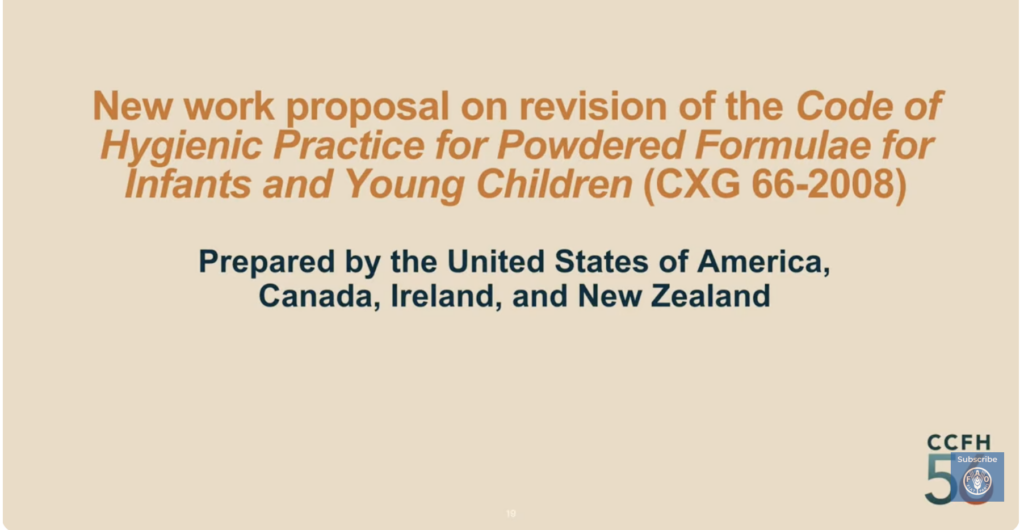
IBFAN, ILCA and ENCA are attending this meeting in Hybrid mode. We are focusing on the need to prioritise a Revision of the Code of Hygienic Practice for Powdered Formulae for Infants and Young Children (CXC 66-2008), the need full compliance with the International Code and Resolutions and for “Competent authorities to exercise due diligence in relation to their independence and oversight of food businesses operators.”
On the first day, as it had announced at CCNFSDU45, the USA proposed to chair a new work Proposal alongside Canada, Ireland and New Zealand. India, on the Revision of the Code of hygienic practice for powdered formulae for infants and young children (CXC 66- 2008). The US proposal will take into account the advice from Report of the FAO WHO JEMRA meeting. jemra-pf_finalther
Click here for a report on CCFH55 (Dec 2025) when we asked CCFH to start work updating the PIF Guidelines
IBFAN HYBRID request for CCFH56th
_________________________________________
© BVL / Czybik & Schmid Media / Thomas Geiger
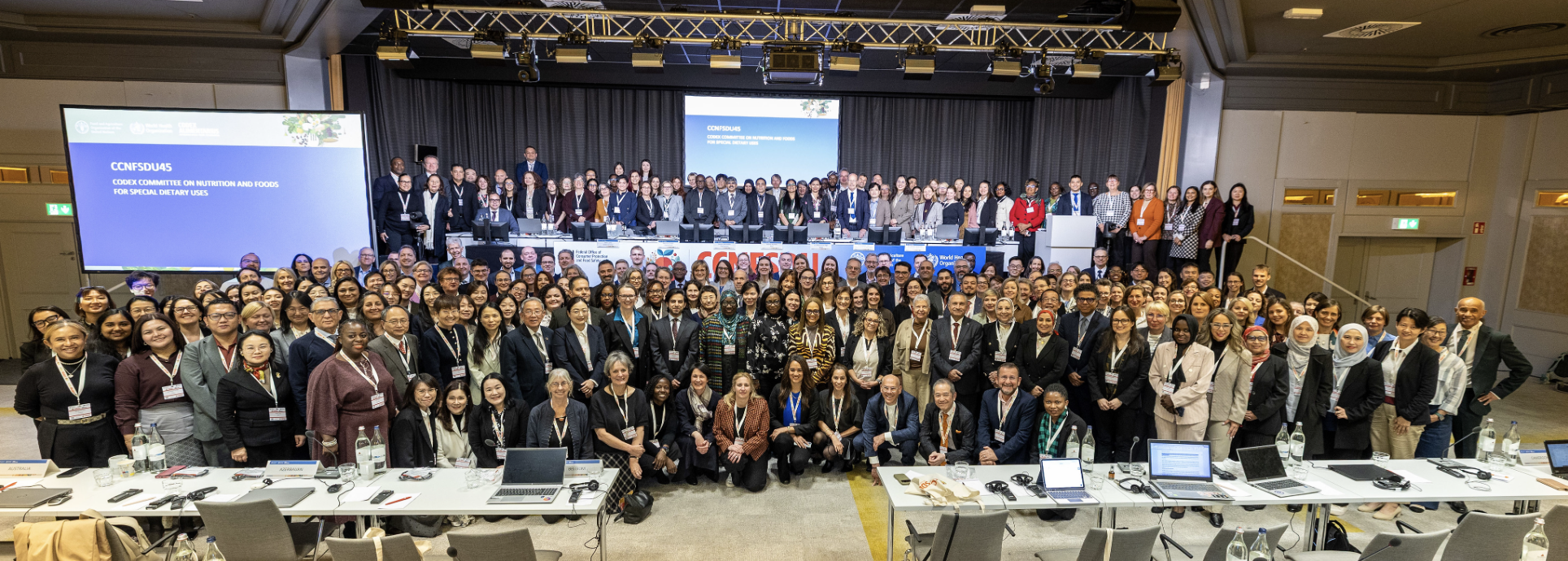
CCNFSDU45 – Codex Committee on Nutrition and Foods for Special Dietary Uses. 2-6 Nov 2026. Nuremberg, Germany.
DRAFT Participants List IBFAN ENCA CRD 40. UNICEF CRD 38
The main topics for the week were Nutrient Values for foods for children 6-36 months Draft Standard for foods for older infants and young children and a Proposal to review and revise the Guideline for Vitamin and Mineral Food Supplements.
DRAFT STANDARD FOR FOODS FOR OLDER INFANTS AND YOUNG CHILDREN (Agenda Item 5) chaired by the USA, with co-chairs, the European Union, Kenya and Panama. Saudi Arabia took over the chair of this item on Wednesday.

© BVL /Thomas Geiger
IBFAN, ICLA, ENCA UNICEF, WHO, the EU, Brazil, Norway and many developing countries consistently highlighted the need for safeguardsThere was near unanimous support for a strong Preamble and General Principles that should include many of the safeguards that we were calling for: clear statements about continued breastfeeding; that the products are not necessary and should not replace real foods, no added sweeteners and sugars and clear mention of the Code and Resolutions. However, nothing is settled and the discussions will continue for many years.
General Principle 1: FFOIYC [should] [could] [shall] [only] be fed in addition to continued breastfeeding or use of formulas, and [could] be a complement to family foods [as part of a diversified diet].
General Principle 2: Primary ingredient(s) of FFOIYC shall be from food groups.
General Principle 3: FFOIYC should be [safe], nutrient dense, contribute nutrients needed to support growth and development [and prevent micronutrient deficiency and wasting].
General Principle 4: Partially hydrogenated vegetable oils, non-nutritive sweeteners, artificial colors and artificial flavors shall not be used as ingredients.
General Principle 5: Amounts of sodium and free/[added] sugars [should] [shall] be limited. [Added sugars are prohibited from FFOIYC.]
General Principle 6: NRVs-R [should] [may] be referenced to derive the nutrient composition.
General Principle 7: FFOIYC should be placed into defined [product] categories [with] specific essential composition [guided by food groups].
General Principle 8: [FFOIYC should support the development healthy eating habits and formulated where appropriate responsive feeding and chewing skills.]
General Principle 9: [FFOIYC should be developed in consideration of relevant World Health Organization (WHO) guidelines and policies and World Health Assembly (WHA) resolutions and be consistent with national/regional health and nutrition policies.]
______________________________________
We made several corrections to the Draft Report including calling for our statements on Conflicts of Interest to be included.
Different views were expressed on the inclusion of a reference to the use of formulas. While some Members supported retaining a reference to formula, others considered that the principle should not imply that formula was required when these foods were consumed and proposed their exclusion and a broader reference to continued breastfeeding and other age-appropriate feeding practices. An Observer noted the importance of screening for conflicts of interest to ensure that the evidence base was free from commercial influence.
This was necessary because the EARLY NUTRITION E-ACADEMY (ENEA) and the European Society Paediatric Gastroenterology, Hepatology & Nutrition (ESPGHAN) (represented by Prof Berthold Koletzko) had defended the positions of the baby food industry (ISDI) arguing that commercial formulas are the only suitable alternative to breastfeeding after 6 months, challenging WHO’s 2023 Guideline for complementary feeding of infants and young children 6-23 months of age. Recommendation 2:
- Milks 6–11 months: for infants 6–11 months of age who are fed milks other than breast milk, either milk formula or animal milk can be fed (conditional, low certainty evidence).
- Milks 12–23 months: for young children 12–23 months of age who are fed milks other than breast milk, animal milk should be fed. Follow-up formulas are not recommended (conditional, low certainty evidence) .
Previous Espghan intervention In 2021, WHO, UNICEF, IBFAN, many Member States and the EU (representing 27 countries) argued for the prohibition of fruit extracts and vanilla flavourings in formulas marketed for children 12-36 months. Espghan argued that a prohibition of flavours would put the formulas “at a disadvantage to ‘less good’ products that don’t meet Codex standards.” successfully preventing consensus on the prohibition. A compromise sentence was added: “National or regional authorities may restrict or prohibit the use of the listed flavourings.” IBFAN argued that idealised images of fresh fruits acting as a health claim, idealising these unnecessary ultra processed processed products. see two IBFAN briefings Industry funding channelled through health professional bodies, such as ESPGHAN, weaken Codex standards. May 2024. How industry funding affects global policy setting on sweetness and flavouring of formulas. November and December 2021
The next CCFSNDU meeting will be April 2028.
_________________________________________________________________________________-
The Codex Committee meeting on Contaminants in Food. (CCCF19) is taking place in (Cairo, Egypt)this week. Monday 19 – Friday 23 October 2026.
IBFAN was represented in person by Dr Ghada Sayed and Patti Rundall represented ENCA online and submitted a Committee Room Document: IBFANENCACRD52.
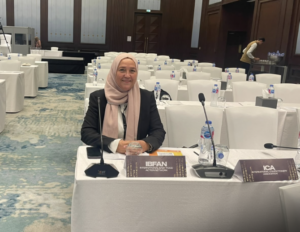
Dr Ghada Sayed for IBFAN
Agenda 4.2 Matters of interest arising from other international organizations (WTO/SPS and STDF) We highlighted PPPs
Agenda 7.2. Code of practice for the reduction of Aflatoxin B1 in raw materials and supplemental feedingstuffs for milk-producing animals (CXC 45-1997) (revision) (at Step 4)
Agenda 10 Proposal for a JECFA call for data on total aflatoxins in cereals and cereal-based foods. We welcomed this proposal from Brazil and JECFA that calls for new data on Maximum Levels (MLs) for total aflatoxins (AFTs) in certain cereals and cereal-based products, including foods for infants and young children,
Agenda Item 11 Discussion paper: Review of the Code of practice for the reduction of acrylamide in foods (CXC 67-2009)
Agenda Item 14. Discussion paper: Development of guidelines on the safe use of recycled plastics in food packaging
WEBCASTING
DAY 0 – Side events: English
DAY 1 – Plenary session: Arabic, English, French, and Spanish
DAY 2 – Plenary session: Arabic, English, French, and Spanish
DAY 3 – Plenary session: Arabic, English, French, and Spanish
DAY 4 – No plenary session
DAY 5 – Adoption of the Report: Arabic, English, French, and Spanish
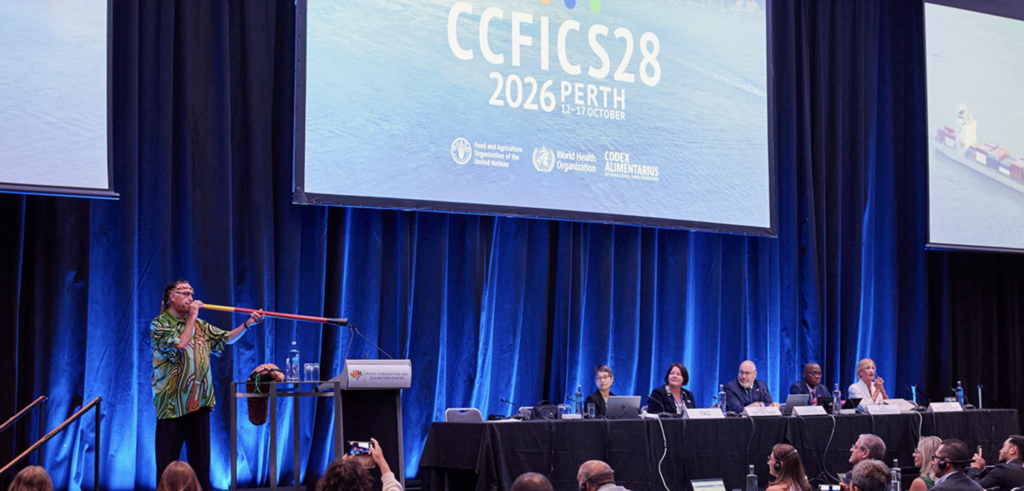
James Webb, from the Noongar tribe, the traditional custodians of the land on which they were meeting, Perth
2 CCFICS28 Codex Committee on Food Import and Export Inspection and Certification Systems. 12/10/2026 – 17/10/2026 Perth, Australia. This meeting will be Webcast with Hybrid Participation, including for the Physical Working Group on Food Fraud on Sunday 11th October.
The Plenary session opened on on Monday (12th October) stressing that Interconnectedness is a key factor in inspection and certification work, as Committee meets for 28th Session.
The Committee was welcomed by James Webb, from the Noongar tribe, the traditional custodians of the land on which they were meeting, Perth. He reminded delegates of the connectedness of people to land and of the need to recognize and respect the flora and fauna of the world around them. “We really do have to look after land; we really do have to look after people,” he urged.
Julie Collins, Minister for Agriculture, Fisheries and Forestry acknowledged the shared responsibility of food safety and security systems and their importance to agricultural industries and to international trade. Setting the tone for subsequent contributions, the Minister spoke to the continued relevance of CCFICS, especially considering “emerging science, environmental changes and geopolitical challenges”. In her welcome remarks, Victoria Anderson, Secretary to the Department of Agriculture, Fisheries and Forestry highlighted the different overarching topics on the CCFICS28 meeting agenda: equivalence, food fraud, traceability and digitalization, “and what they mean for modern regulation and food security”.
For WHO, Simone Moraes Raszl said: “effective, transparent and science-based inspection and certification systems must protect customers, build confidence between trading partners and support fair practices in food trade. For WHO, protecting consumer health must remain at the centre of this work. Strong national food control systems, effective cooperation between competent authorities and timely access to reliable information are essential to prevent and manage food safety risks across borders”.
Keep policy-setting free from commercial influence.
At the Physical Working Group the day before, ENCA, IBFAN and the World Public Health Nutrition Association (WPHNA) called for the inclusion of ONE HEALTH principles in the Preamble of the Draft guidelines on the prevention and control of food fraud.
IBFAN/ENCAs CRD 19 also calls for the reference to ‘building partnerships and collaboration’ to be removed from Para 5 of the Preamble of the Guidance and that national governments should be encouraged to adopt effective conflict of interest safeguards. Due diligence is needed to ensure the independence of Competent Authorities and National Food Control Systems who have the responsibility to monitor, detect, mitigate and prevent food fraud, including through proportionate penalties.
‘Partnerships’ are, by definition, arrangements for ‘shared governance’ to achieve ‘shared goals.’ Indeed, ‘shared decision-making’ is a unifying feature that implies ‘respect, trust, shared benefits.’ The reference to ‘partnerships’ in the Guidance risks undue corporate influence on policy-setting.This can complicate and undermine accountability mechanisms and independent monitoring and assessments. There is ample evidence that the partnership model promotes self-regulation rather than the adoption of regulations, international codes, conventions and treaties. It also reduces national governments’ role as primary actors in the protection of public health.
The business term ‘stakeholder’ is also highly problematic and refers to any individual, group, or organization that has a vested interest in the success, failure, or operations of a business, project, or policy.
Worth reading: The rise of multi-stakeholderism, the power of ultra-processed food corporations, and the implications for global food governance: a network analysis. Slater, S., Lawrence, M., Wood, B. et al. Agric Hum Values 42, 177–192 (2025). https://doi.org/10.1007/s10460-024-10593-0
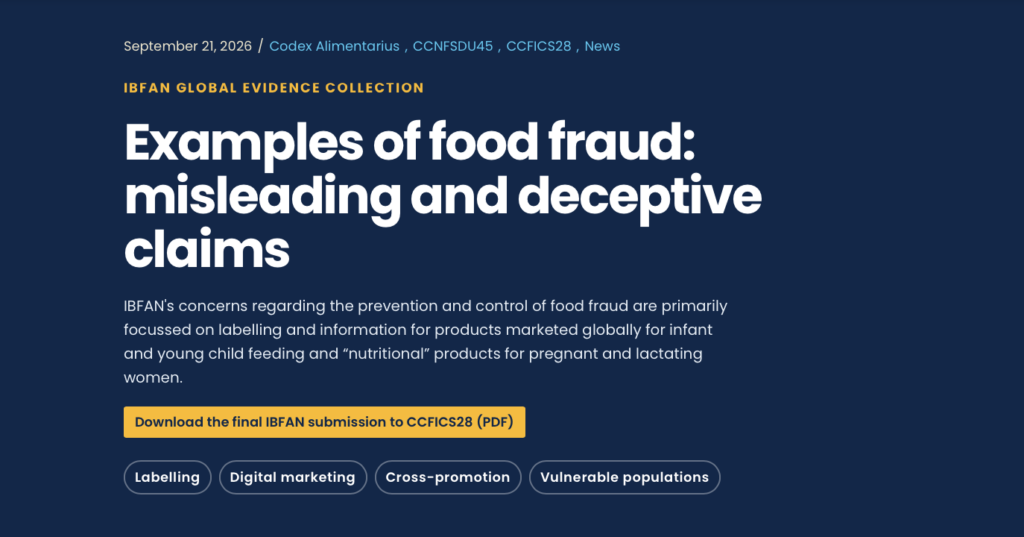
Since Food fraud perpetrated for foods for vulnerable populations is of particular high risk to health and to the economic sustainability of families, Labelling and information for products marketed globally for infant and young child feeding and “nutritional” products for pregnant and lactating women, deserve special consideration. Misrepresentation and false misinformation on product labels and via digital and other marketing methods is invariably intentional, and undermines breastfeeding and recommended optimal feeding practices that are based on culturally appropriate family foods.
- An over-arching concern is that the draft Guidance (Preamble Para 5) envisages two contradictory roles for Competent Authorities. (CA) and National Food Control Systems’ (NFCS). Firstly, and rightly, CAs and NFCS are expected to provide “regulatory oversight and increasing awareness about food fraud.” At the same time, they are expected to
IBFAN/ ENCA CRD CCFICS IBFAN COMMENT on the Draft guidelines on the prevention and control of food fraud. ENCA comment Examples of food fraud: misleading and deceptive claims
IBFAN and ENCA comments on the List of Emerging Global Issues.
The recent large-scale recalls of commercial formula (including infant formula) products contaminated with difficult to remove spore-forming and toxin producing bacteria – Clostridium botulinum and Bacillus cereus has eroded parents’ trust in commercial food systems. The systemic failures in formula production, regulatory surveillance, recall systems and crisis communication have highlighted the urgent need for consistent, regular, independent and transparent regulatory oversight of manufacturing facilities. Recalls in over 60 countries demonstrate the high-risk nature of commercial formulas that can lead to serious illness and possibly death in a vulnerable population. Border control capacity must be increased and strengthened to manage imports of these high-risk products that are subject to frequent recalls. The lack of regulation of cross-border digital marketing and sale of products for infants and young children, adds to the food safety risks to child health. Parents are pressured into buying potentially contaminated products with idealised, misleading claims that products are manufactured with an ‘abundance of caution.’ Parents place their trust in manufacturers and when children fall sick, are left with denial, robotic answerphone messages, limited treatment and no access to information or support. Protection of breastfeeding through due diligence regarding conflicts of interest safeguards and full implementation of the International Code and Resolutions is urgently needed.
Complex Food chain:
The food chain is increasingly complex and globalized with novel processes that the public has no hope of understanding. While food businesses are responsible and must be held accountable for the microbiological safety and quality of both the ingredients and the final product. They should also have verification procedures in place to audit and select ingredient suppliers. However, it is inevitable that there will be negligence and human error within manufacturing facilities that result in health risks. Transparency regarding this is essential.
Regulatory bodies must not shirk their responsibilities to monitor, regularly inspect and audit businesses. There has been a shockingly poor and unequal response from health authorities regarding the recent contamination crisis, with no transparency or explanations about what really happened or how the crises were managed. From a consumer perspective, the dual mandate of Codex – both to protect and consumer health and to facilitate fair trade –compromises the credibility of Codex when it comes to acknowledging and dealing with the safety and quality of highly processed products. The minimal warnings and marketing safeguards in Codex standards have boosted the global trade of addictive, plastic-wrapped products to such an extent that it will be a major challenge for Codex to properly acknowledge their risks – the health risks alongside the fossil-fuel-intensive agriculture, mono-cropping, deforestation and land-grabbing – and follow a One Health approach. Nevertheless, from a human rights and planetary health perspective, this is essential and we strongly advocate that local food producers (none more local than breastfeeding mothers) and traditional cultures are prioritised.
The task of import and export operators to ensure that products are safe will be impossible unless these issues are frankly and honestly addressed and there is prior oversight by independent authorities of food safety systems. The system must not be left in the hands of financially interested parties. Last but not least, whistleblowers must be listened to.
2. CCNFSDU45 The 45th Session of the Committee on Nutrition and Foods for Special Dietary Uses Nuremberg, Germany 2 – 6 November 2026.
Physical working group (PWG) Sunday, 1 November 2026: Standard for foods for older infants and young children and Review and prioritization of new work proposals
CCNFSDU45 – Side Event: Monday 13:45 – 14:45 CET WHO food profiling tool for regulatory measures
CCNFSDU45 – Side Event Tuesday 2nd November 13:45 – 14:45 CET. New Working practices for the incorporation and endorsement of food additive provisions in Codex texts
UNICEF Implementation Guidance on Policies and Programmes.
UNICEF and All Comments on Standard IBFAN and ENCA
UNICEF Implementation Guidance on Policies and Programmes for Improving Complementary Feeding. A modular resource for governments, programme managers and advocates
Complementary-feeding-nutrition-culture-and-politics Amazon. by Gabrielle Palmer
_________________________________________________________
________________________________________________________________
The Codex Food Labelling Committee (CCFL) will probably not meet again till 2028, but there is a Circular Letter calling for information to inform a strategic forward work plan – The deadline is 2nd November 2026.
| CL 2026/79-FL | Request for information to inform a strategic forward workplan for CCFL including emerging issues/future work | 2 November 2026 |
| Request for information to inform a strategic forward workplan for CCFL including emerging issues/future work | 02/11/2026 |
The ENCA CRD34 calling for an International Guideline for the protection of whistleblowers is up https://codex.fao.org/restapi/searchMeetingDocument/fh56_crd34x.pdf?lang=ol&id=122448
CCCF19. Committee on Contaminants in Foods 19 Oct 2026–23 Oct 2026 Cairo, Egypt
| CL 2026/60-CF | 0/ | Request for comments on the recommendations for the development of guidelines on the safe use of recycled plastics in food packaging | 05/10/2026 |  |
CCEURO34 – FAO/WHO Coordinating Committee for Europe 21 Sep 2026–25 Sep 2026Berlin, Germany. AGENDA
Codex Calendar for 2026
CCEURO34 (Berlin, Germany): Monday 21 – Friday 25 September 2026. Registration here.
CCMMP11 (by correspondence): Tuesday 29 September – Thursday 29 October 2026. Registration here.
CCFICS28 (Perth, Australia): Monday 12 – Saturday 17 October 2026. Registration here.
CCCF19 (Cairo, Egypt): Monday 19 – Friday 23 October 2026. Registration here.
CCNFSDU45 (Nuremberg, Germany): Monday 2 – Friday 6 November 2026. Registration here.
CCFH56 (Arizona, USA): Monday 16 – Friday 20 November 2026. Registration here.
CCLAC24 (Uruguay): Monday 23 – Friday 27 November 2026. Registration here.