Codex flexible labelling guidelines have serious risks for child health and survival
Codex Commission (CAC49) Geneva, Switzerland, 6-10th July
Codex Labelling Committee (CCFL49) Ottawa, Canada 11-15 May 2026
“With 117.8 million people forced to flee their homes, facing food insecurity and scarce water and sanitation, allowing weaker product labelling – especially for formulas and baby products – is an unacceptable contradiction of human rights principles.” UNHCR statistics
IBFAN, ENCA ILCA, and WPHNA attended (in person and remotely) the 49th Labelling Committee in Ottawa in May and will also attend the Codex Alimentarius Commission (CAC49) in July. The CAC decides whether Codex texts are ready for final adoption.
IBFAN is concerned that the Codex Guidelines – proposed by the USA – could legitimise weak ‘flexible’ labelling and ingredients of products used during emergencies, including formulas and baby foods. In response to concerns from member states and IBFAN and ENCA, some safeguards were added during the Labelling Committee in May, however, essential ones are missing.
A major problem is that the safety of the Guidelines depends on Competent Authorities(1) having strong emergency preparedness procedures in place that ensure inadequate labelling and product composition changes are recognised and disallowed. Since is not the case, the Guidelines open the door to double standards and exploitation of the most vulnerable.
Please help by contacting your MP, your government representative or their Codex contact point to ask for the guidelines to be returned to CCFL for more work. At the very least formulas and foods for infants and young children must be EXCLUDED and the Code of Ethics for International Trade in Food (CXC 20-1979) included. This Code mentions the International Code of Marketing of Breast-milk Substitutes and WHA Resolutions in Article 4.4.
Summary of our concerns:
1: Defining an emergency is a highly sensitive political action that should never be influenced by commercial or market considerations.
2: Codex has a dual mandate to both protect health and facilitate fair trade (unlike UNICEF and WHO with single mandates to protect the right to health). Codex texts are compromised and their weaknesses are used by corporations and exporting countries to undermine laws and policies that seek to protect health.
4. Few national governments have strong emergency preparedness plans so many will not recognise and forbid exploitative labelling such as the two examples above. The potential for exploitation by the food industry to use this as a way to shift food products that may not meet legal standards is real.
5: During emergencies child deaths can be two to 70 times higher than the average rate. The risks of not breastfeeding during the first six months are greatly increased when water and sanitation are scarce and basic hygiene breaks down. While all mothers have the right to decide how to feed their children, the uncontrolled donation and distribution of formula becomes a lethal risk – made worse if labels are idealised and warnings are missing or unreadable. This is why full implementation of the International Code and Resolutions is essential.
6: For agencies and NGOs working in emergency relief, flexible labelling can complicate the traceability and recall procedures of contaminated or unsafe food. Formula contaminated with Cereulide was exported to Ukraine, the Gaza Strip and West Bank.
(10 According the Codex, a Competent Authority is the official government body or authorized agency responsible for setting regulatory food safety requirements, organizing official controls, and enforcing compliance
Agenda Item 4.7. IBFAN/ENCA Comment on the Application of Food Labelling Provisions in Emergencies
IBFAN and ENCA recommend that the Guidelines on the Application of Food Labelling Provisions in Emergencies should be discontinued. Our fall-back position is that they should be returned for more work, and, at the very least, formulas and foods for babies should be specifically EXCLUDED and specific reference is made the Codex Code of Ethics for International Trade in Food.
While the proposed guidelines contain some high level ‘guardrails’ they fail to include essential safeguards or details of how flexibilities will be monitored.[1] So the Guidelines will inevitably open the door to double standards and exploitation of the most vulnerable – the millions of people enduring conflict, occupation, displacement and who face severe food insecurity. In such contexts a two tiered food labelling system is an unacceptable contradiction of human rights principles.
CCFL49 acknowledged that the Guidelines create risks, but despite many requests, those promoting them failed to provide examples explaining their need or how, in the case of infant feeding, weaker labelling of commercial formulas (products that present serious risks at the best of times) could be safe when water, sanitation and facilities for preparation are reduced or absent.
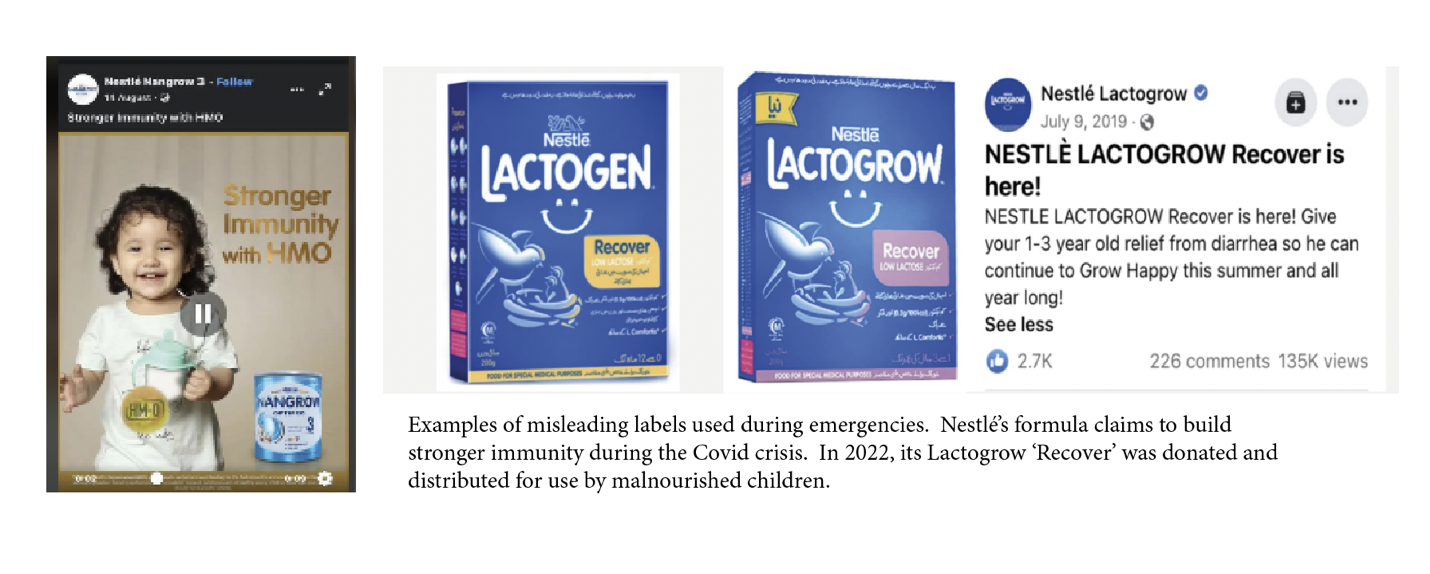
Among other weaknesses, the Guidelines promote technology-based approaches with no mention of WHA Resolution 78.18 that prohibits and warns of the risks of digital promotion of baby formulas and foods. Nothing is said about idealisation. For example, the commercial formulas that claimed to provide immunity against infections during the Covid 19 Pandemic.[2] Or the formulas carrying brand names such as ‘Recover’ donated and distributed for use by malnourished children In Pakistan during the 2022 floods. Such distribution could worsen a child’s nutritional status and health and even lead to death. [3]
The absence of clear, standardized labelling can complicate the traceability and recall of contaminated or unsafe food, especially when infrastructure is broken.[4]
IBFAN and ENCA oppose the Guidelines proceeding. Our fall-back position is that they should be returned for more work and at the very least, formulas and foods for babies should be specifically EXCLUDED.
notes:
[1] Foods for infants and young children provided in emergencies must comply with all the provisions of the International Code of Marketing of Breastmilk Substitutes and subsequent World Health Assembly Resolutions[1] and the Operational Guidance on Infant Feeding in Emergencies (OG-IFE) version 3.0 (Oct 2017) to ensure that breastfeeding is protected as the safe and secure feeding in emergencies to safeguard infant and young child health and lives. The Guidelines should also include Principle 5 of Codex Principles and Guideline for National Food Control Systems: and Article 4.4 of the Code of Ethics for International Trade in Food – CXC–20-1979
[2] How companies are exploiting the COVID-19 pandemic..
[3] For more examples: Contaminated Commercial Milk Formula: A global response is needed. Infant Feeding in Emergencies Core Group. IFE WHA79 Advocacy
[4] https://www.ibfan.org Other recall examples: Kendamil cereulide recall, Canada (February 2026) – ingredient swap due to a shortage causing a batch of contaminated formula, nearly 9 months between production anRecommend recall, highlighting the lag between contamination and traceability. ByHeart botulism recall, US (November 2025) – 31+ infants hospitalized; complicated by the company’s active donation program to food-insecure families – a direct parallel to humanitarian distribution
RASFF NOTIFICATION 2026.0347 Recall of infant formulae produced in Switzerland, possibly contaminated with cereulide sent from Switzerland to Ukraine, the Gaza Strip and West Bank. https://webgate.ec.europa.eu/rasff-window/screen/notification/816985
_____________________________________________________________________.
CAC49 Daily TIMETABLE Report CCFL49The debate on the guideline is on paras 116-139. The list of Participants Pages 21 -34 The Guidelines Page 41-42
Codex Commission Codex Food Labelling (CCFL49) Ottawa, Canada 11 – 15 May 2026. Webcast Tuesday Webcast Friday
Joint FAO/WHO Expert Meeting on Microbiological Risk Assessment (JEMRA) on microbiological risk assessment on powdered formulae for infants and young children FAO HQ, Rome, Italy, 15 – 19 June 2026. This meeting will update existing risk assessment and scientific advice on environmental pathogens in order to strengthen “control measures across the production environment, covering all stages from primary production and packaging through to the reconstitution of the product, and including environmental monitoring programmes.”
Health promotion in the digital era: leveraging potential, reducing risks 11 June, 2026. EuroHealthNet.
“The health harms of online platforms may not always be obvious to legislators and decision-makers. Presenting evidence in an actionable way should be one of the public health community’s highest priorities if we are to drive meaningful policy change across Europe.”
Kremlin Wickramasinghe. Regional Advisor, WHO Europe, Prevention & Health Promotion
Contaminated Commercial Milk Formula: A global response is needed.
Infant Feeding in Emergencies Core Group. IFE WHA79 Advocacy
(1) The EWG summary states that: “In general, most competent authorities regarded that they have the authority, either explicitly stated or implied/embedded within existing interpretations of authorizing legislation, to implement flexibilities to food labelling as necessary in times of emergency.”
IBFAN’s full submission to the Codex Labelling Committee is here: IBFAN CCFL49.Ag 7 Codex National Contact points HERE