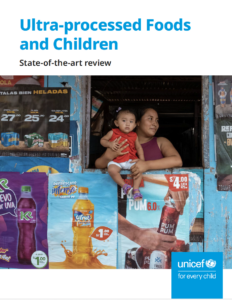
Ultra-processed Foods and Children: State-of-the-art review
2.12.25
This state-of-the-art review on ultra-processed foods (UPF) and children consolidates evidence from around the world on how rising UPF consumption undermines children’s nutrition, health and well-being. The review finds strong evidence that UPF intake in children is linked with poor diet quality, overweight and obesity, and dental caries. A growing body of research also associates UPF intake in children with undernutrition, micronutrient deficiencies, mental health concerns, metabolic changes and an increased risk of chronic diseases later in life. This evidence provides the basis for advocating for and developing stronger legal measures and policies to counter the rise of UPFs in children’s diets through actions that protect children’s food environments and place child rights before commercial interests.
 Ultra-processed foods: time to put health before profit
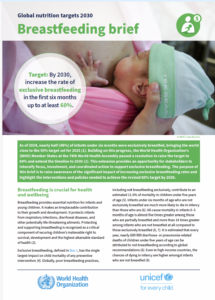 Global Nutrition Targets 2030 Breastfeeding Brief from WHO and UNICEF PDF
Overview
Exclusive breastfeeding – defined as the practice of only giving an infant breast-milk for the first 6 months of life (no other food or water) – has the single largest potential impact on child mortality of any preventive intervention. Exclusive breastfeeding provides essential, irreplaceable nutrition for a child’s growth and development. It provides protection from respiratory infections, diarrhoeal disease, and other potentially life-threatening ailments. Exclusive breastfeeding also has a protective effect against obesity and certain noncommunicable diseases later in life.
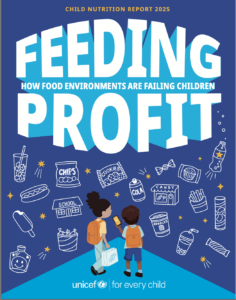 Feeding Profit
How food environments are failing children.
United Nations Children’s Fund (UNICEF), Feeding
Profit. How food environments are failing children. Child Nutrition Report 2025, UNICEF, New York, September 2025.
IBFAN Statement on Medela September 2025
ATNi_Corporate_accountability_in_food_system_governance
__________________________________________________
The rise of multi-stakeholderism, the power of ultra-processed food corporations, and the implications for global food governance: a network analysis. Open access Published: Cite this article Scott Slater, Mark Lawrence, Benjamin Wood, Paulo Serodio, Amber Van Den Akker & Phillip Baker
________________________________________________
Corporate Power and Human Rights in Food Systems.
The final report of the United Nations Special Rapporteur on the Right to Food, Mr. Michael Fakhri will be presented to the UN General Assembly on 17 October 2025. language versions HERE
Corporate power in food systems is highly concentrated, allowing a relatively small group of people to shape food systems in a way that serves the ultimate goal of profit maximization instead of the public good. In the present report, the Special Rapporteur examines how a relatively small number of corporations have amassed so much power over our food systems and outlines what is to be done to: curtail corporate power; ensure food markets are fair and stable; and hold corporations accountable for human rights violations in food systems.
Some excerpts: 17. Most alarming is the disproportionate targeting of children. Food and beverage marketing is pervasive, with the majority of food types marketed to children as part of an approach aimed at influencing their preferences, requests, purchases and eating behaviours, and increasing the risk of childhood obesity. Relatedly, despite the prohibition on advertising and other forms of breast-milk substitutes, some industry tactics include marketing practices that spreading false health and nutrition claims, the cross-promotion of milks and associated brands for infants, toddlers, older children and adults, as well as lobbying and the use of trade associations and front groups.25
_____________________________________________________
Commercial determinants of infant and child health: A focus on Nestlé’s baby food products marketed in Africa
IBFAN calls on UNESCO to end its education collaboration with Nestlé
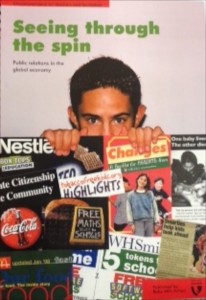
From the archive – IBFAN papers on CORPORATIONS IN EDUCATION
Tackling Obesity Schools Feb 12
Seeing through the Spin (Education pack)