Why Nestlé continues to be a threat to human and planetary health
November 2025
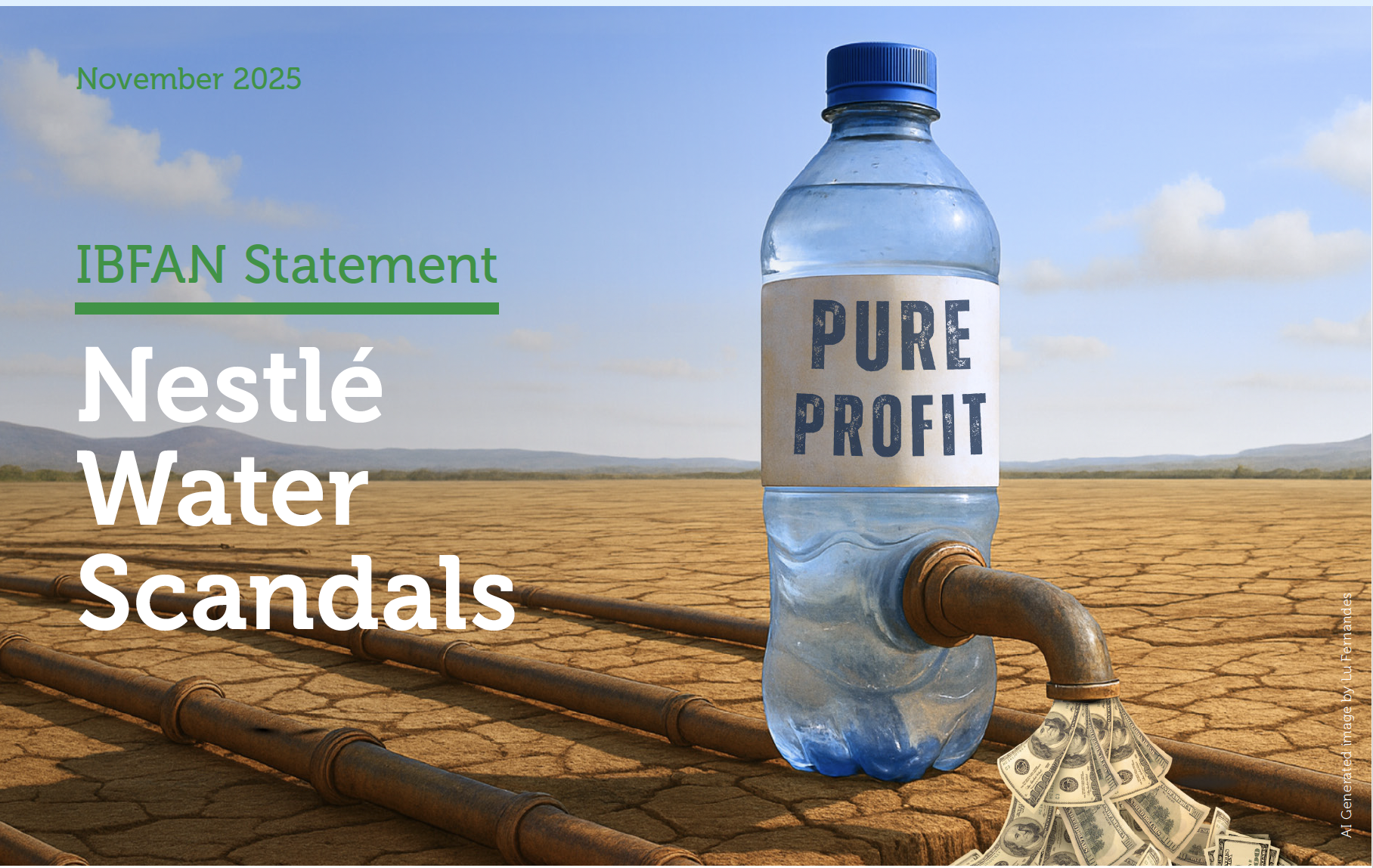
Severe and increasing droughts caused by the climate crisis exacerbate water shortages and environmental pollution. In time for COP 30 in Brazil, IBFAN’s Statement ‘Nestlé Water Scandals’ addressed the exploitation of scarce water resources for profit, depleting the precious groundwater supplies of communities all over the world and leaving large amounts of waste contaminated by microplastics. IBFAN’s Statement provided additional information to UNESCO Directors to support our request that they end their partnership with Nestlé
The baby food issue has rightly earned Nestlé the “baby killer” label. As the market leader, Nestlé’s refusal to abide by the International Code of Marketing of Breast-milk Substitutes and subsequent WHA Resolutions remains a serious threat to infant and young child health and survival. Nestlé’s egregious marketing undermines breasfeeding, a resilient practice that provides food, care, immune support and protection including during the worst of emergency conditions. Nestlé also undermines confidence in and use of bio-diverse family foods by flooding markets with poor quality ultra-processed snacks, drinks and foods.iii
50-70% percent of Nestlé’s 2000-brand food and drink portfolio is deemed to be ultra-processed and unhealthy and Nestlé shareholders refused a call to change the marketing strategy at its 2024 Annual Assembly. (4).
Ultra-Processing is an issue that the global food industry is probably unable to tackle, and for the first time was on the Codex agenda in November 2025. Since 1995 IBFAN has advocated that all Codex standards and Guidelines should be brought into line with World Health Assembly recommendations.
The dual mandate of Codex – both to protect and consumer health and to facilitate fair trade – fundamentally compromises and undermines its credibility as a leader on UPFs. Codex has, after all, boosted the global trade of addictive, plastic wrapped UPFs for decades. Click Here and Here
Environmental Nestlé is a major contributor to plastic pollution, intensive agriculture, risky technologies, monocropping, and land-and sea-grabbing. Click here
Nestlé continues to face charges of child slavery (5)
Nestlé’s WATER business. CLICK HERE for our paper on Nestlé’s Water Scandals.
The company has already been fined 2 million Euros for illegal treatment of its boaled mineral water brands, in a 3 billion Euros consumer fraud that lasted over 15 years. Nestlé paid this fine to avoid legal action.vi Nestlé is currently facing criminal proceedings in France this November, with charges of illegal waste disposal and contamination linked to pollution by plasic boales.
EDUCATION Nestlé has been running its Healthy Kids programs in schools since the early 1990s and has admitted that its key purpose is to ‘improve the company’s reputation’ and ‘legitimately communicate its socially responsible intentions to adults.’ IBFAN believes that education should be free from undue political and commercial influence should also be considered a fundamental human right. Education materials are a more complex problem than straightforward product advertising because they blur the boundaries between advertising, marketing and independent information. When linked to prestigious institutions the ‘halo’ effect gains the trust of children, teachers and parents and diverts attention from a company’s anti-social actions.
Nestlé’s baby food products may not be worse than other products – some may even be less risky – but Nestlé is shown that it is not a company that should be trusted. It has a recurring pattern of operation that clearly prioritises profit over environmental sustainability, regulatory compliance, and human health.
Syngenta is a member of the official Swiss delegation to COP 30