© FAO/Roberto Sciotti
Protecting independent science as Codex tackles UPF
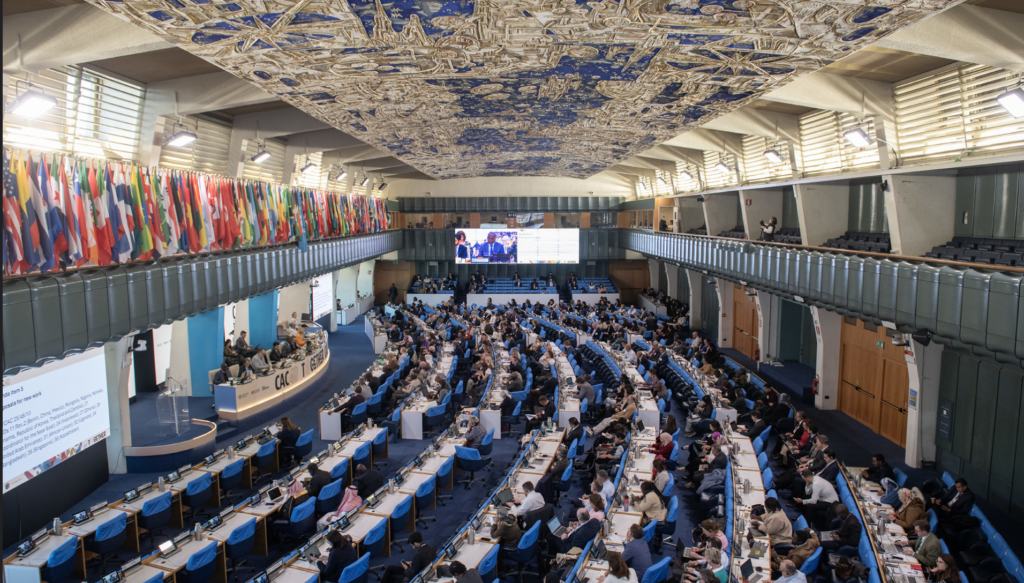
CAC48 Rome 10-14th November
Meeting detail. REPORT Participants.
WEBCASTING. DAY 1: AM | PM DAY 2: AM | PM DAY 3: AM | PM. Day 4
IBFAN attended the 48th Codex Alimentarius Commission (CAC) in Rome last week, once more raising the need for greater protection of children and due diligence in the scientific process. For the first time Ultra Processed Foods (UPF) were on the Codex agenda, reflecting the growing concern of the harm to human and planetary caused by these products. As the new Lancet report states: “UPFs are branded, commercial formulations made from cheap ingredients, with little or no whole food, designed to compete with the other three Nova groups and their preparation as dishes and meals, and maximise corporate profits.”
As WHO announced its new work on a definition and guidance for UPFs, the Union of Food scientists and Technology (IUFoST) proposed that instead, Codex should take the lead: “Given the interconnectedness of health, agriculture, and trade policies, Codex leadership is essential to ensure that food classification systems remain evidence-based, fair, and harmonized at the international level.” IBFAN, the EU and many countries strongly supported the WHO proposal so the IUFoST proposal was not taken up. From a consumer perspective, the dual mandate of Codex – both to protect and consumer health and to facilitate fair trade – fundamentally compromises the credibility of Codex for this task. Over the years the minimal warnings and marketing safeguards in Codex standards have boosted the global trade of these addictive, plastic wrapped products. It is a major challenge for Codex to properly follow a One Health approach and prioritise local food producers and traditional cultures rather than transnational corporations, dominated by a handful of companies such as Nestlé, PepsiCo, Unilever, and Coca-Cola. One thing Codex must do is acknowledge and limit the impact of UPFs on the environment – fossil-fuel-intensive agriculture, mono-cropping, deforestation, land-grabbing. (IBFAN Statement ( DAY 3: AM | PM)
WHO on One Health? What is the UNFCCC Triple Planetary Crisis?
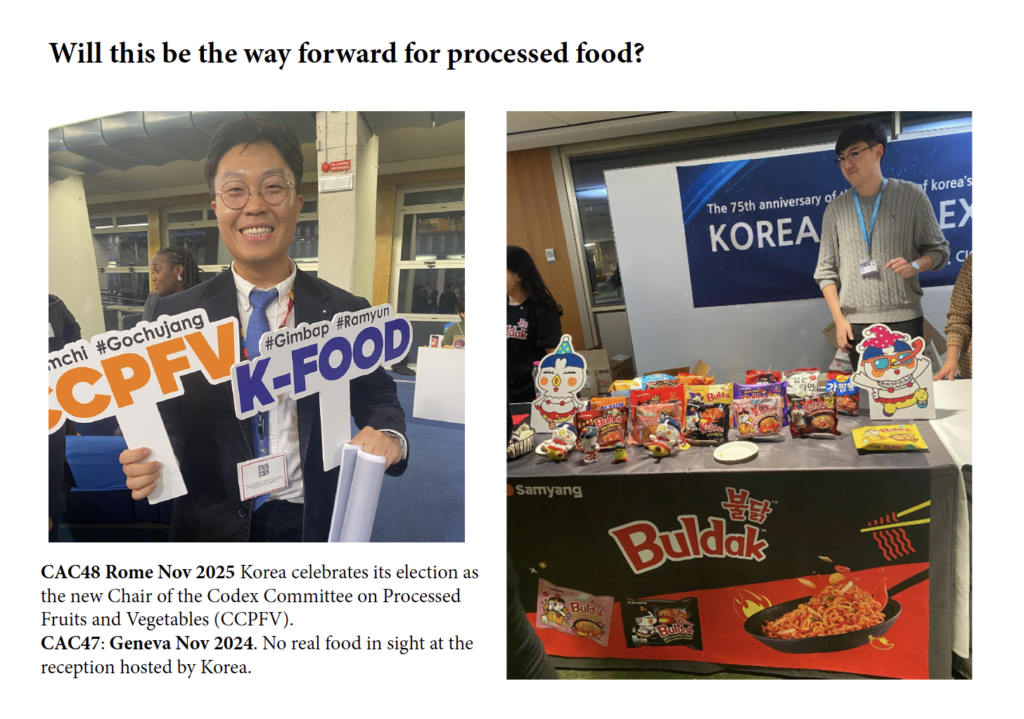
Korea was elected at the Chair of the Codex Committee on Processed Fruits and Vegetables. (CCPFV)
IBFAN supported a new work proposal submitted by the European Union: Development of principles for the risk analysis of new food sources and production systems (NFPS). We noted that the proliferation of innovations in NFPS has led to many confusing claims in baby foods and there is an urgent need for greater diligence in the scientific process to avoid possible conflicts of interest. Several countries questioned the need for the proposal, some insisting that the production of cell-based and other innovations should not held back. IBFAN STATEMENT DAY 2: AM. move to 2.14
- On the Monitoring of the new Codex Strategic Plan we called for the analysis to be frank and not gloss over the problems that exist. The Plan must prioritise consumer safety and given the many wars and climate crises must prevent emergencies being exploited to create new markets for ultra processed baby foods. IBFAN Statement DAY 3: AM
- Matters from FAO and WHO We called on Codex members to bring their legislation into line with WHO recommendations and the revised Codex standard on follow-up formula, to cover all marketing products for babies. We strongly supported WHO’s recommendations on Conflicts of Interest, including following the closure of the Codex Trust Fund. (IBFAN Statement Day 3 PM)
Since 1995, IBFAN has advocated policy coherence between Codex standards and the recommendations of the World Health Assembly, in particular the International Code, the Global Strategy and the WHA Resolutions on infant and young child feeding. Lack of transparency, poor conflict of interest safeguards and the dominance of food corporations and powerful exporting nations has resulted in the adoption of many standards that do not protect health and are not fit for purpose. These standards have been used for decades as a ‘regulatory ceiling’ for trade purposes to the detriment of the health and survival of infants and children. Codex standards have also contributed to the undermining of bio-diverse, traditional food cultures, as well as the deforestation, mono-cropping and land and sea-grabbing that has had a devastating impact on human and planetary health and rights. Largely as a result of IBFAN’s advocacy, Codex standards on baby foods have been improved and refer to some extent to WHA recommendations, opening the door to much better regulation.
Agenda Item 8. Codex strategic plan 2026-2031 – Monitoring framework
IBFAN contributed to the discussions on the Strategic Plan, hoping that Codex could transform its procedures and support the broader goals of sustainability, one health, food security and environmental protection. Below are some of IBFAN’s suggestions:
- Adopt stricter Transparency and Conflict of Interest safeguards to ensure that Codex decisions are protected from commercial influence and based on relevant and convincing evidence.
- Allocate sufficient time to the prioritization of Codex work taking into account the potential harm of poor codex standards and unnecessary products on human and planetary health.
- Codex should stop its standards being used as a ‘regulatory ceiling.’ Governments have the sovereign right to adopt any legislation they consider necessary to protect human health as long as it does not violate international trade principles.
- Public funding of the Codex Trust fund must be written into the Codex Manual
- Safeguards regarding products for Emergencies. Flexible labelling and flexible nutrient and ingredient content – especially in relation to infants and young children, is not consistent with Codex principles and is likely to put vulnerable populations at risk, compromising the health of those already in vulnerable situations.
© FAO/Roberto Sciotti
Short statements from Lancet authors
Carlos Monteira Phil Baker Simon Barquera
Exclusive: Many industries on new council are ‘associated with significant health harms’, one academic says