2026
Two new publications exploring women’s experience of breastfeeding in India and the UK:
Navigating Public Spaces: Women’s Coping Strategies for Breastfeeding in Urban India.Nupur Bidla, Archana Dassi, 5.1.26 Preventive Medicine Research & Reviews
This new study by BPNI’s Nupur Bedlam explores how urban women struggle with stigma and discomfort when breastfeeding in public spaces. A major challenge was the sexualization of breasts in urban India, which led to feelings of discomfort, shame, and fear of judgment. Through semi-structured interviews with educated and socioeconomically independent metropolitan women the study examines women’s coping strategies such as covers, discreet seating, feeding before leaving home, and planning outings around feeding schedules. Important reading for advocates, policymakers, and healthcare providers working to foster a more supportive environment. Click Here
Bidla, Nupur1; Dassi, Archana2. Navigating Public Spaces: Women’s Coping Strategies for Breastfeeding in Urban India. Preventive Medicine Research & Reviews ():10.4103/PMRR.PMRR_5_25, January 05, 2026. | DOI: 10.4103/PMRR.PMRR_5_25
______________________________________________
An exploratory analysis of enablers of exclusive breastfeeding in England: Positive deviance in practice, Meg O’Loughlin, Regina Murphy Keith. School of Life Sciences, University of Westminster, London, United Kingdom. World Nutrition 2025
This qualitative research explored exclusive breastfeeding in England, through interviews with mothers who practiced positive deviance by exclusively breastfeeding, alongside midwives and breastfeeding advocates, who facilitated the practice, to inform future policy and practice change.
O’Loughlin M., & Keith R.M.2025.“An exploratory analysis of enablers of exclusive breastfeeding in England: Positive deviance in practice.”World Nutrition,16(4), December,55–68
PROTECTING CHILDREN FROM UNHEALTHY FOOD MARKETING
A Toolkit for Developing Effective Laws
Model Legal Language for Protecting Children from Unhealthy Food Marketing
UNICEF’s new digital toolkit and Model Legal Language for protecting children from unhealthy and ultra-processed food marketing is now live: This resource is designed to help governments move from commitment to action – with step-by-step guidance and ready-to-use legal language to develop laws that are not only strong on paper, but effective in practice.
Two new UNICEF reports:
Feeding ProfitUltra-processed Foods and Children
How food environments are failing children.
United Nations Children’s Fund (UNICEF), Feeding Profit. How food environments are failing children. Child Nutrition Report 2025, UNICEF, New York, September 2025.
_________________________________________
IBFAN Statement on Medela September 2025
Code Report 2024 Presentation PDF
ATNi_Corporate_accountability_in_food_system_governance
__________________________________________________
The rise of multi-stakeholderism, the power of ultra-processed food corporations, and the implications for global food governance: a network analysis. Open access Published: Cite this article Scott Slater, Mark Lawrence, Benjamin Wood, Paulo Serodio, Amber Van Den Akker & Phillip Baker
_____________________________________________________
Fejerskov AM, (2025). Private Foundations and Global Health Governance: A Case Study of the Novo Nordisk Foundation. United Nation University International Institute for Global Health, Kuala Lumpur.
| :
As the rapidly ascends to become one of the world’s largest foundations, this new UNU-IIGH research paper provides a rigorous analysis of its historical trajectory, distinctive commercial foundation structure, and evolving strategic orientations; elucidating the ways in which its substantial financial resources and expanding international prominence anchor it as a pivotal actor in shaping scientific research and health policy. Spotlighting the potential vulnerabilities and accountability concerns linked to the incursions of powerful private actors (PPAs) in global health governance, the authors raise questions about the porous boundaries between NNF’s philanthropic objectives and commercial interests, especially concerning transparency, research priorities, market incentives, policy directions, and equitable health outcomes.Read the full briefing paper here: https://go.unu.edu/JaD0l
United Nations University | DIIS – Dansk Institut for Internationale Studier | Adam Moe Fejerskov | David McCoy | Katerini Tagmatarchi Storeng | Dian Maria Blandina
hashtagUNU hashtagUNUIIGH hashtagHealthGovernance hashtagPhilanthropy hashtagPhilanthrocapitalism hashtagNovoNordiskFoundation hashtagGlobalHealth hashtagPower hashtagAccountability hashtagCommercialfoundation hashtagPPA hashtagGlobalHealthGovernance hashtagHealthPolicy hashtagTransparency hashtagGHAgenda
_______________________________________________________
Corporate Power and Human Rights in Food Systems.
The final report of the United Nations Special Rapporteur on the Right to Food, Mr. Michael Fakhri will be presented to the UN General Assembly on 17 October 2025. language versions HERE
Corporate power in food systems is highly concentrated, allowing a relatively small group of people to shape food systems in a way that serves the ultimate goal of profit maximization instead of the public good. In the present report, the Special Rapporteur examines how a relatively small number of corporations have amassed so much power over our food systems and outlines what is to be done to: curtail corporate power; ensure food markets are fair and stable; and hold corporations accountable for human rights violations in food systems.
Some excerpts: 17. Most alarming is the disproportionate targeting of children. Food and beverage marketing is pervasive, with the majority of food types marketed to children as part of an approach aimed at influencing their preferences, requests, purchases and eating behaviours, and increasing the risk of childhood obesity. Relatedly, despite the prohibition on advertising and other forms of breast-milk substitutes, some industry tactics include marketing practices that spreading false health and nutrition claims, the cross-promotion of milks and associated brands for infants, toddlers, older children and adults, as well as lobbying and the use of trade associations and front groups.25
_____________________________________________________
Commercial determinants of infant and child health: A focus on Nestlé’s baby food products marketed in Africa
______________________________________
IBFAN calls on UNESCO to end its education collaboration with Nestlé
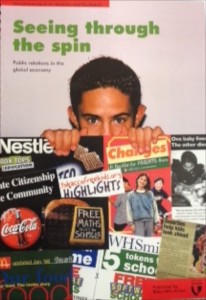
For the archive – IBFAN papers on CORPORATIONS IN EDUCATION
Tackling Obesity Schools Feb 12
Seeing through the Spin (Education pack)
Recent publications on Conflicts of interest in the Future Healthcare Journal:
Trade, investment and nutrition: Status update and policy coherence challenges of the United Nations decade of action on nutrition
DOI: https://doi.org/10.26596/wn.202516181-96
Specialised Infant Formulas: Overused, Overpriced and Obesogenic
____________________
Save the Children report on Digital Marketing of Breastmilk Substitutes:How social media and influencer marketing undermine informed choice
Digital Marketing of BMS – Scoping Review_Final-Report_Jul2024
__________________________
Pakistani breast milk bank closes after Islamic clerics withdraw approval.
Doctors deplore decision and point to country’s high neonatal mortality rate as bank, which opened in June, forced to close without taking a single deposit Zofeen T Ebrahim in Karachi Mon 8 Jul 2024. https://www.theguardian.com/global-development/article/2024/jul/08/pakistani-breast-milk-bank-closes-after-islamic-clerics-withdraw-approval
_______________________________________________________
CHILD FOOD POVERTY. Nutrition deprivation in early childhood
https://www.unicef.org/media/157871/file/CNR%202024%20-%20Child%20Food%20Poverty%20-%20Data%20tables%20-%20Final.pdf.pdf?utm_campaign=WINS%20%7C%20Child%20Food%20Poverty&utm_medium=email&utm_source=Mailjet
___________________________________________________–
Meanwhile another piece of research linked to the Gates Foundation with less than transparent Declaration of Interest:Tobacco-like plant engineered to pump out nutrients found in breast milk.Breakthrough could pave way for formula milk that more closely replicates health benefits of breastfeeding . Hannah Devlin Science correspondent. The Guardian Sun 16 Jun 2024
________________________________________________________
Ultra-processed foods need tobacco-style warnings, says scientistUPFs should also be heavily taxed due to impact on health and mortality, says scientist who coined term. Andrew GregoryHealth editor Thu 27 Jun 2024 https://www.theguardian.com/global/article/2024/jun/27/ultra-processed-foods-need-tobacco-style-warnings-says-scientist
_________________________________________________
Academic and doctor Chris van Tulleken: ‘Ultra-processed products are food that lies to us’ https://www.theguardian.com/food/article/2024/may/19/academic-and-doctor-chris-van-tulleken-ultra-processed-products-are-food-that-lies-to-us?CMP=share_btn_url
____________________________________________________
New WHO report on Digital Marketing:Restricting digital marketing in the context of tobacco, alcohol, food and beverages, and breast-milk substitutes – Existing approaches and policy options. https://www.who.int/publications/i/item/9789240077249
Corporate interest groups and their implications for global food governance: mapping and analysing the global corporate influence network of the transnational ultra-processed food industry. Scott Slater”*®, Mark Lawrence 2, Benjamin Wood’, Paulo Serodio and Phillip Baker https://twitter.com/SlaterS0103/status/1761916897472446612/photo/1
6th February 2024. Cindy Alejandra Pachón Robles, Mélissa Mialon, Laís Amaral Mais, Daniela Neri, Kimielle Cristina Silva & Phillip Baker Globalization and Health volume 20, Article number: 12 (2024)
_________________________________________________________________
Phillip Baker, PhD Julie P Smith, PhD Prof Amandine Garde, PhD Laurence M Grummer-Strawn, PhD Benjamin Wood, MD Prof Gita Sen, PhD et al.
Published:February 07, 2023DOI:https://doi.org/10.1016/S0140-6736(22)01933-X
https://www.thelancet.com/journals/lancet/article/PIIS0140-6736(22)01933-X/fulltext
__________________________________________________________

Ultra-processed foods (UPF) in the diets of infants and young children in the UK. What they are, how they harm health, and what needs to be done to reduce intakes
Written by Rachel Childs and Dr Vicky Sibson. Published in 2023 by First Steps Nutrition Trust. We would like to thank Dr Helen Crawley (founder and former director of First Steps Nutrition Trust) and Rob Percival (Trustee of First Steps Nutrition Trust) for their comments and input into this report, as well as the various academics we consulted for their advice, or input as cited. This resource is provided for information only and individual advice on diet and health should always be sought from appropriate health professionals. Content of this resource can be reproduced in other materials provided they promote public health and make no profit, and an acknowledgement is made to First Steps Nutrition Trust.
Published in 2023 by First Steps Nutrition Trust.Published in 2023 by First Steps Nutrition Trust.Published in 2023 by First Steps Nutrition Trust.
From the ARCHIVES:
Whistleblowing, Food Safety and Fraud. by Yasmine Motarjimi
Yasmine Motarjemi – Nestlé Whistleblower.

Milking Profits
Report with evidence from Nestl whistleblower Syed Aamir Raza. 1999.
Dr Tedros explains why marketing is so harmful. March 2022
Breastfeeding and the Immune system
When SUN casts a Shadow
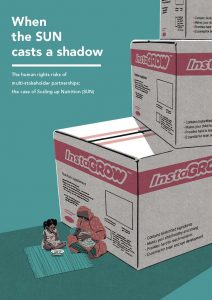
Blog with a summary of the findings of our report on SUN – When Sun Casts a Shadow
The report: When the Sun casts a Shadow
Multi-stakeholder Partnerships: What are the risks? The case of Scaling Up Nutrition (SUN)
SUN Spotlight_2019 SUN-GAIN-2014 SUN IBFAN 28.11.12
Multi-stakeholderism
Multistakeholderism. Dialogue or engineering of consent? Opportunities and risks of talking to industry by Judith Richter
Interference in public health policy :
Baby food and Tobacco tactics.

World Nutrition Issue. Vol 8 No 2 (2017)
Abstract
Despite countries’ commitments to improve nutrition, starting with the protection of breastfeeding, aggressive marketing of breastmilk substitutes continues to promote their indiscriminate use. The baby food industry appears to use similar interference tactics as the tobacco industry to influence public health, promote their products and expand their markets.
Learning from the tobacco experience, this paper assesses whether the baby food industry uses any of the six tobacco industry interference tactics recognized by the World Health Organization (WHO) and summarizes examples of documented evidence.
We conclude that the baby food industry uses all six tactics: (1) manoeuvring to hijack the political and legislative process; (2) exaggerating economic importance of the industry; (3) manipulating public opinion to gain appearance of respectability; (4) fabricating support through front groups; (5) discrediting proven science; and (6) intimidating governments with litigation. There is abundant anecdotal evidence. Published evidence is limited and varies by tactic. Examples of interference are provided for the Philippines, Vietnam, Laos, Turkey, Ecuador, Hong Kong, Mexico and the United Kingdom, and most for Tactic 3.
Interference in public health policies shows commonalities between the two industries. The tobacco control movement offers a useful framework for classifying and addressing interference with public policy by the baby food industry. Revealing the depth and extent of interference used by the baby food industry is critical if countries are to counter interference and implement commitments to improve nutrition.
________________________________________
Interviews in the Journal of Human Lactation (JHL)
Interviews by Maryse Arendt, IBCLC, BSEd with key IBFAN figures:
Anwar Fazal-A Breastfeeding Advocate Extraordinaire Anwar Fazal has been a driving force in the founding of several civil society organizations in the areas of health, human rights, environment, and peace, that have been at the forefront of activism locally, nationally, and globally. In this interview, he shares his journey of 6 decades, involving a multiverse of public interest issues, which led him into the breastfeeding movement. It began with the setting up of the International Baby Food Action Network (IBFAN), a pioneering action that triggered the formation of Health Action International (HAI), Pesticide Action Network (PAN), and the World Alliance for Breastfeeding Action (WABA). Each of these resulted in several unique frameworks and codes relating to the marketing of infant foods, pharmaceuticals, and pesticides….. link: Anwar Fazal—A Breastfeeding Advocate Extraordinaire – Anwar Fazal Dato’ Seri, Maryse Arendt, 2024 Anwar Fazal PDF
Leah Margulies: The Power of Consumer Activism: An Interview With Leah Margulies1 [Part 1]. An Interview with Leah Margulies (part 1)
The Power of Consumer Activism From the Kennedy Hearings to the International Code: An Interview With Leah Margulies (Part II). An Interview with Leah Margulies (part 2)
Marina Ferreira Rea: A Militant Doctor active in the Endless Fight for Breastfeeding
as a Human Right – A Luta Continua! https://journals.sagepub.com/doi/full/10.1177/08903344211057122
Patti Rundall: A Passionate Activist, Full of Energy https://journals.sagepub.com/eprint/GJWE24XFBNER48ADTTNB/full and permanent link for institutional Access: https://doi.org/10.1177/0890334420971552 https://journals.sagepub.com/doi/10.1177/0890334420971552?url_ver=Z39.88-2003&rfr_id=ori:rid:crossref.org&rfr_dat=cr_pub%20%200pubmed
Annelies Allain: Pioneer of the International Code of Marketing of Breastmilk Substitutes https://journals.sagepub.com/doi/full/10.1177/0890334418812075 2018 https://journals.sagepub.com/doi/10.1177/0890334418812075?url_ver=Z39.88-2003&rfr_id=ori:rid:crossref.org&rfr_dat=cr_pub%20%200pubmed
Lida Lhotska and Judith Richter 2019: Protecting breastfeeding from conflicts of interest https://journals.sagepub.com/doi/pdf/10.1177/0890334419885859 December 9, 2019 Research Article Lida Lhotska, BSc, PhD, Judith Richter, MSc, MA, PhD
Gabrielle Palmer 2021 https://journals.sagepub.com/doi/10.1177/08903344211015624?url_ver=Z39.88-2003&rfr_id=ori:rid:crossref.org&rfr_dat=cr_pub%20%200pubmed
Interviews by others:
Doug Johnson: Advocacy, Strategy and Tactics Used to Confront Corporate Power: The Nestlé Boycott and International Code of Marketing of Breast-milk Substitutes https://journals.sagepub.com/doi/10.1177/0890334420955158 open
David Clark 2020: Defender of Human Rights and Breastfeeding
and David Lawson Clark, LLB [HONS] interviewed by Laurence M. Grummer-Strawn, MPA, MA, Ph https://journals.sagepub.com/doi/full/10.1177/0890334420902685
Felicity Savage King:2017 https://journals.sagepub.com/doi/full/10.1177/0890334417726321
Larry 2017 https://journals.sagepub.com/doi/full/10.1177/0890334417699393
Margaret Kyenkya 2020 https://journals.sagepub.com/doi/full/10.1177/0890334420926951
History of IBFAN: Annelies https://journals.sagepub.com/doi/full/10.1177/08903344211041374
News of IBFAN: Betty Sterken 4 times a year
Doug Johnson Reprint of 1986 article (2020). Confronting corporate power: Strategies and phases of the Nestle Boycott. Journal of Human Lactation, https://journals.sagepub.com/doi/10.1177/0890334420964752 (This article was previously published in Research in Corporate Social Performance and Policy, © 1986; 8: 323-344 by JAI Press Inc.)
Reply Annelies Allain https://journals.sagepub.com/doi/full/10.1177/08903344211049396
Reply Doug https://journals.sagepub.com/doi/pdf/10.1177/08903344211038930
Codex. CCFL Advocacy at Work During the Codex Committee on Food Labelling Meeting https://journals.sagepub.com/doi/full/10.1177/08903344211057083
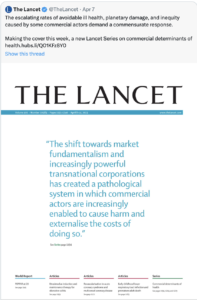
Commercial Determinants of Health
Executive Summary
Commercial actors can contribute positively to health and society, and many do, providing essential products and services. However, a substantial group of commercial actors are escalating avoidable levels of ill health, planetary damage, and inequity—the commercial determinants of health. While policy solutions are available, they are not currently being implemented, and the costs of harm caused by some products and practices are coming at a great cost to individuals and society.
A new Lancet Series on the commercial determinants of health provides recommendations and frameworks to foster a better understanding of the diversity of the commercial world, potential pathways to health harms or benefits, and the need for regulatory action and investment in enterprises that advance health, wellbeing, equity, and society.
_________________________
Articles on Codex
Some interesting articles that might explain the struggle we had getting Codex on the agenda of WHA75:
here is our press release:Global trading standards must follow WHO in restricting harmful marketing
Industry Lobbying on WHO Overshadowing Public Health Policy, Researchers Suggest
Corporate Dollars Elevate Commercial Interests Over Health Expertise. by May 18, 2022
The Breast is the World’s Shortest Supply Chain. Stop Being Squeamish and Start Working on Better Breastfeeding Policies. The Commons. Katheryn Russ. May 19, 202
(2) Russ K, Baker P, Byrd M, et al. What you don’t know about the Codex can hurt you: how trade policy trumps global health governance in infant and young child nutrition. International Journal of Health Policy and Management 2021; 10(12): 983-97. Baker et al. Globalization and Health (2021) 17:58. Advocacy at Work During the Codex Committee on Food Labelling Meeting
Baker et al. Globalization and Health (2021) 17:58. https://doi.org/10.1186/s12992-021-00708-1
Codex. Advocacy at Work During the Codex Committee on Food Labelling Meeting https://journals.sagepub.com/doi/full/10.1177/08903344211057083
______________________________________________________
Articles on Ultra-Processed Food
The industry side of the argument: https://www.wired.com/story/processed-food-health-meat-substitute-environment/ from an online journal called WIRED,
_______________________________________
Money Control: The Bournvita Debate: Is shooting the messenger helpful?
Premature Deaths Attributable to the Consumption of Ultraprocessed Foods in Brazil
American Journal of Preventive Medicine 10.1016/j.amepre.2022.08.013 2022)
This New study shows that increased consumption of UPF was associated with more than 10% of all-cause premature, preventable deaths in Brazil in 2019, although Brazilians consume far less of these products than countries with high incomes. https://www.eurekalert.org/news-releases/970082.
Maternal consumption of ultra-processed foods and subsequent risk of offspring overweight or obesity: results from three prospective cohort studies
https://pubmed.ncbi.nlm.nih.gov/36198411/
The trouble with ultra-processed foods
BMJ 2022; 378 doi: https://doi.org/10.1136/bmj.o1972 (Published 31 August 2022)Cite this as: BMJ 2022;378:o1972https://www.bmj.com/content/378/bmj.o1972
Interesting and ironic. you partner with same food Industry that destroys the diet and then call on Member States to do their bit to achieve nutrition targets. #WHA75 https://t.co/fsPaEz4hD3
— Dr. Arun Gupta MD FIAP (Ped) (@Moveribfan) May 28, 2022
Contaminants and Residues in baby feeding products
IBFAN GIFA Contaminants and Residue website
Environment chemical and microbiological contamination of infant feeding products
Green Feeding – action on climate change
Valerie McClain’s Blogspot: Humanmilkpatentpending
_________________________________________________________
Infant feeding in Emergency Tools
IYCF-E Toolkit: https://resourcecentre.savethechildren.net/toolkits/iycf-e-toolkit/
IYCF-E Curriculum: https://resourcecentre.savethechildren.net/toolkits/curriculum/ (English and Spanish versions are currently uploaded. French will be uploaded very soon. Stay tuned!)
IYCF-E Hub: https://iycfehub.org/
And the newly released report:
Infant and Young Child Feeding in Emergencies: Ten Years of Progress https://iycfehub.org/document/infant-and-young-child-feeding-in-emergencies-ten-years-of-progress/
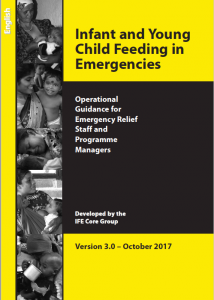
The Global Operational Guidance for Infant and Young Child Feeding in Emergencies is now available in Hindi, the official language in India and spoken as the mother tongue in 7 countries, reaching 572 million people. Below is a tile that you can use for sharing. The guidance and our other resources can be found here: https://www.ennonline.net/ife/iferesourcesoutputs
Operational Guidance V3 OCT 2017
The GNC Technical Alliance and IFE Core Group is planning to conduct Webinar:
“Communicating IYCF-E during an emergency”
‘’ Infant and Young Child Feeding in Emergencies and the role of Media: Getting the right message across’’
The IFE Core Group is currently collecting examples of communication and/or media initiatives that are related to Infant and Young Child Feeding in Emergencies. We are seeking suggestions, recommendations, and tested experiences from colleagues working in humanitarian emergencies/crises and fragile contexts who have experienced or have observed how communication and media are used in relation to infant and young child feeding in emergencies (IYCF–E).
Media and communication colleagues have a great role in raising attention and awareness around the needs and concerns of populations affected by emergencies. To provide your inputs please fill in the questionnaire in the link below.
Please complete the questionnaire:
In English here. In Spanish here In French here. In Arabic here
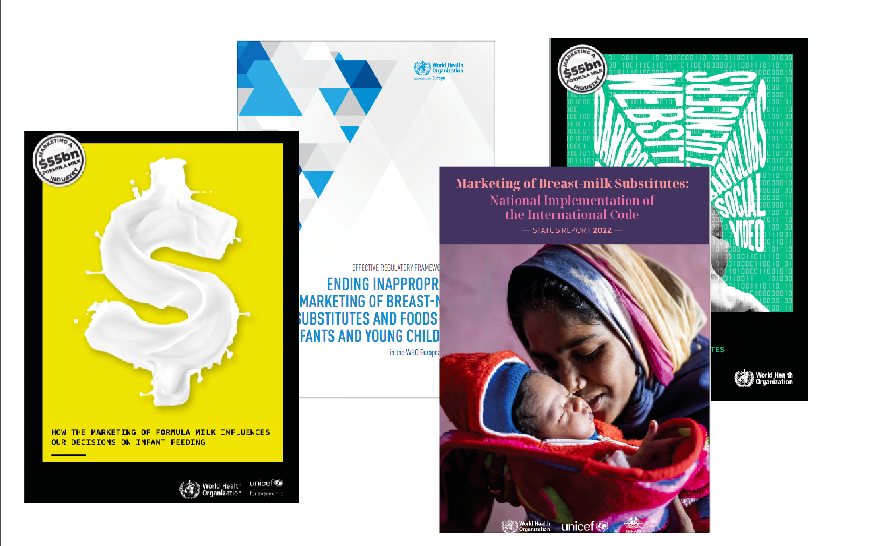
ENDING INAPPROPRIATE MARKETING OF BREAST-MILK SUBSTITUTES AND FOODS FOR INFANTS AND YOUNG CHILDREN
The WHO European Region: protecting the most vulnerable
Coinciding with the launch of the new WHO–UNICEF global report: “How marketing of formula milk influences our decisions on infant feeding” IBFAN welcomes this an important new Policy Brief produced by the WHO Regional Office for Europe. The Policy Brief includes a “model law”, developed specifically for the Region, to demonstrate what effective regulations should look like.
The aggressive formula milk marketing is especially worrying for the WHO European Region. Of all the WHO regions, it has the lowest levels of exclusive breastfeeding for children. The new WHO data show that 84% of pregnant and postpartum women in the United Kingdom are exposed to formula milk marketing.
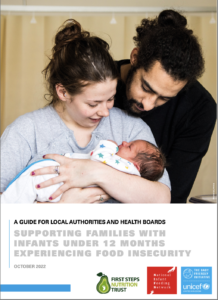
This report provides recommendations for local authorities operating food banks and includes the following linkages with emergency planning: “All Local Authorities should have an infant feeding strategy produced in partnership with the Local Maternity System or Integrated Care Partnership (or equivalent) which can be cross-referenced to the emergency preparedness plan.” This guidance document was produced by the UNICEF UK Baby Friendly Initiative, First Steps Nutrition Trust and the National Infant Feeding Network (NIFN) and replaces the Baby Feeding Law Group guidance on formula in food banks.
Bill Gates
How Bill Gates and partners used their clout to control the global Covid response — with little oversight
https://www.politico.com/news/2022/09/14/global-covid-pandemic-response-bill-gates-partners-00053969
Four health organizations, working closely together, spent almost $10 billion on responding to Covid across the world. But they lacked the scrutiny of governments, and fell short of their own goals, a POLITICO and WELT investigation found. When Covid-19 struck, the governments of the world weren’t prepared. From America to Europe to Asia, they veered from minimizing the threat to closing their borders in ill-fated attempts to quell a viral spread that soon enveloped the world. While the most powerful nations looked inward, four non-governmental global health organizations began making plans for a life-or-death struggle against a virus that would know no boundaries.
_________________________________-
Articles on Maternity Protection

Maternity protection for female non-standard workers in South Africa: the case of domestic workers
BMC Pregnancy and Childbirth volume 22, Article number: 657 (2022)
MATERNITY LEGISLATION
IBFAN Position Paper on Maternity Protection at Work.
Thanks to Elisabeth Sterken and Maryse Arendt for this work.
MONITORING REPORTS
Marketing of breast-milk substitutes: national implementation of the international code, status repor
t 2022 WHO UNICEF IBFAN
STOP PRESS: Questioning the ethics of international research on formula milk supplementation in low-income African countries Doherty et al. BMJ Global Health.
Global evidence of persistent violations of the International Code of Marketing of Breast-milk Substitutes: A systematic scoping review
__________________________________________
THE CLIMATE EMERGENCY
Taking action now, worldwide – and from birth. First we need to talk about:
- global heating – not global warming
- climate emergency – not climate change
The UK and Ireland officially declared an environment and climate emergency in May 2019, followed by Canada declaring a national climate emergency in June 2019.
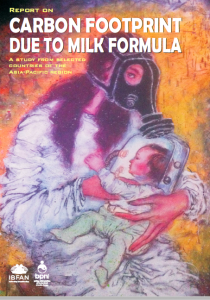 CLICK HERE for the carbon footprint report.
CLICK HERE FOR GREENFEEDING AND OTHER BRIEFINGS
The carbon footprint of breastmilk substitutes in comparison with breastfeeding
Johan O. Karlsson, Tara Garnett, Nigel C. Rollins, Elin Roos
_______________________
CORPORATIONS IN SCHOOLS
Tackling Obesity Schools Feb 12
Seeing through the Spin (Education pack)
__________________________
WHISTLEBLOWERS
http://archive.babymilkaction.org/pdfs/milkingprofits.pdf
WHO and UNICEF advice on breastfeeding and coronavirus
- UNICEF: Response to COVID-19: Guidance Note on Financial Contributions or Contributions in-kind from Food and Beverage companies Version 2 (29th April 2020)
- This is an important guidance on whether to accept financial contributions or contributions in-kind from food and beverage companies in the context of the response to the COVID19 pandemic. It provides recommendations to mitigate risks and steps for implementation, forbidding many of the tactics that manufacturers of baby foods and ultra-processed foods high in fats, sugar and/or salt are now using, eg cause-related marketing, contributions in kind, partnership language, co-branding.
- Protecting Maternal Diets and Nutrition Services and Practices in the Context of COVID-19 Ensure safeguards are in place to avoid conflict of interest from companies marketing breastmilk substitutes and foods for infants and young children and women and ensure that donations or free supplies are prohibited. Prevent commercial exploitation of COVID-19 through unnecessary use of specialized foods and supplements, and spillover to those who do not need them
- Frequently Asked Questions: Breastfeeding and COVID-19. (7th May 2020) WHO. With web story. The The FAQ/Decision tree will be translated into Arabic, Chinese, French, Russian and Spanish soon
- UNICEF: ADOPTION OF BREASTFEEDING RECOMMENDATIONS IN THE CONTEXT OF COVID-19KEY FINDINGS FROM AN ONLINE SURVEY IN LOW-AND MIDDLE-INCOME COUNTRIES (September 2020)
- Unicef UK Guide for local authorities First Steps Nutrition Trust. UK UNICEF Baby Friendly Initiative
- Counselling Cards on Infant and Young Child Feeding in the Context of COVID-19 UNICEF (Issue 6 April 27)
- Infant and Young Child programming in the context of COVID-19. UNICEF Brief 2 V1 30th March
- WHO Interim guidance 13 March 2020,
- WHO Advice for the Africa region, 26th March 2020
- WHO Q&A for the public (18th March 2020).
- UNICEF Brief No 1 on Child Wasting.
________________________________________
Some briefings from First Steps Nutrition, Baby Feeding Law Group and UNICEF
First Steps Nutrition Trust Briefings
Supporting families experiencing food insecurity
BFLG / Trussell position on formula in food banks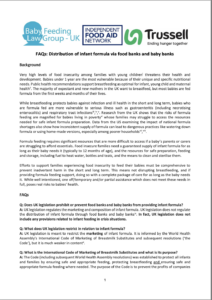
Unicef BFI/ FSNT / NIFN guidance for local authorities (October 2022)
The briefing below has been superseded by new guidance:
Information for Food Banks, supporting pregnant women and families with infants