Mailings 2026
30th September 2026
IBFAN calls for strong safeguards in the draft Codex standard on foods for older infants and young children
The upcoming Codex meetings on Nutrition in Nuremberg, Germany (CCFFSDU), Food Fraud in Perth, Australia, Contaminants in Cairo and Food Hygiene in Arizona, USA, could all have a profound impact on maternal and child health.
Codex standards are used as a baseline for national legislation, so should, at the least, be in line with World Health Assembly recommendations. The dominance of food corporations and powerful exporting nations, has resulted in weak Codex standards that are used in attempts to stop governments bringing in strong marketing controls, including at the WTO – wrongly treating Codex standards as a ‘regulatory ceiling’ for trade purposes.
IBFAN comments on the Baby Food Standard – Summary below.
IBFAN is specifically calling for:
- a clear statement that commercial foods for older infants and young children must not replace culturally appropriate and locally available family foods.
- full alignment with the International Code and relevant World Health Assembly resolutions and WHO Guideline for complementary feeding of infants and young children 6–23 months of age.
- no labelling or marketing that suggests complementary foods should be introduced before six months;
- strict controls on added sugars, sugar-contributing ingredients, sweeteners, salt, trans fats and artificial flavourings;
- protection against misleading health, nutrition and idealising claims;
- clear labelling and marketing controls distinguishing ordinary commercial foods from Foods for Special Medical Purposes and Ready-to-Use Therapeutic Foods;
- safeguards against unnecessary or inadequately tested optional ingredients;
- effective controls on chemical and microbial contaminants, pesticides, herbicides, heavy metals and harmful processing practices;
- packaging requirements that protect children’s health and the environment; and measures to prevent commercial products from undermining responsive feeding, chewing, oral development and children’s ability to recognise hunger and fullness.
- No promotion of ‘snacks’ and puréed foods in pouches.These products may encourage children to suck food while reclining instead of sitting, chewing and learning to eat foods with a variety of textures, colours, aromas and tastes. During this critical learning stage children develop food preferences and eating patterns that may continue throughout life.
- Protection against commercial interference in policy setting
The development of the new standard must be transparent and protected from commercial influence. Standards intended to protect infants and young children should be based on independent evidence and public health recommendations, not on the commercial objective of expanding global markets for packaged and ultra-processed foods.
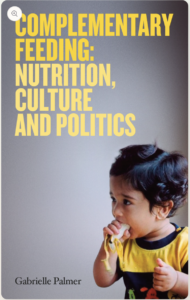 Complementary Feeding: Nutrition, Culture and Politics
This important book by our Patron, Gabrielle Palmer, explores the importance of local foods, family diets and food security while examining how aggressive marketing can create demand for unnecessary or unsuitable commercial baby foods.
Find out more from the publisher
Kindle edition on Amazon UK
UK News – Healthy Babies Programme
We warmly welcome the announcement this week of the Healthy Babies Programme (modelled on Sure Start). The lack of adequate support for breastfeeding in the UK is adding to the distress families face – especially those on low-income – with far too many resorting to extortionately priced formulas and unhealthy commercial baby foods. Sure Start was introduced in 1999 under the last Labour government, led by David Blunkett and Tessa Jowell and its importance is universally acknowledged. Its funding was slashed under the Conservatives.
The Guardian. BMJ. Nursery World:
“Something is missing in half of communities … the Healthy Babies services – mental health support for mums and dad, the feeding and bonding support for your new baby. That changes now,” Cooper will say.
“We will bring back the Sure Start health services into every family centre. One of the Labour party’s greatest achievements, restored to families throughout the land.”
Sure Start and its successor programmes are seen as integral to the narrative of the modern Labour party, with housing secretary Angela Rayner saying her life as a teenage mother and that of her son were turned around by her local centre, which offered her a parenting course.
Poor quality commercial baby foods
There is growing concern in the UK about the poor quality of commercial baby and toddler foods one year after publication of the voluntary industry baby food guidelines (deadline Feb 2027). Analyses by Impact on Urban Health question the voluntary approach, and found 81% faiure on added sugar and 97% failure on promotional claims. A Which? Interim Assessment (Aug 26) reported that over a fifth of four-to-five-year-olds are overweight or obese and over a fifth of five-year-olds have experienced tooth decay.
For conflict-of-interest-free information on UK developments see First Steps Nutrition Trust and the Baby Feeding Law Group that we founded in 1997. Both organisations promote stronger regulation and controls on marketing and provide key resources for healthcare professionals seeking independent information.
__________________________________________________________
September 11th 2026
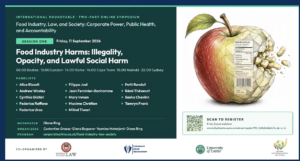 11&18 September: Two Round Tables on Food Industry Harms.
Join us today and next Friday for this important two-part international roundtable “Food Industry, Law, and Society: Corporate Power, Public Health, and Accountability organised by the Corporate Crime Observatory (CCO), Boston College Law School, Exeter Law School, and the Global Harmonization Initiative and of course and the Nestlé whistleblower, Yasmine Motarjemi. CLICK HERE for local times and registration
“The harms associated with the food industry cannot be understood adequately through food safety law alone The harms associated with the food industry cannot be understood adequately through food safety law alone. Some take legally recognizable forms, including contamination, adulteration, food fraud, mislabeling, false claims, kickbacks, procurement abuse, price fixing, and cartel conduct. Others occur despite the existence of legal rules, inspection powers, and corporate compliance systems, but remain difficult to detect because relevant information sits inside. corporations, contracts, supply chains, and commercial arrangements. A third category concerns products and commercial practices that comply with existing rules while potentially contributing to cumulative public-health or social harm.”
Codex news:
Examples of fraudulent claims on foods CLICK HERE and HERE
|
Experts, families and governments unite in Geneva to demand a global response to the infant formula contamination crisis

IBFAN, ILCA, COLANSA, The van Tulleken Foundation, Burundi, Panama and Ecuador.
CLICK HERE for YouTube recording of Side Event and IBFAN’s WHA79 statements
IBFAN BROCHURE Summary of Side event
Geneva, 22 May 2026 – IBFAN and ILCA co-hosted an official Side Event at WHO Headquarters, bringing together food safety experts, representatives from WHO, UNICEF, EU Parliament, Member States and Young people to discuss the global infant formula contamination crisis and the need for a coordinated response. The session was chaired by Dr Zoe Faulkner, Member of the Board of Directors of ILCA. Speakers included: Dr Joan Matji, Chief of Nutrition and Food Security at UNICEF, Dr Carmen Savelli, WHO Food Safety, Dr Simone MORAES RASZL, WHO’s Unit Head for Scientific Advice and Standards, Dr Bob Boyle, Associate Professor of Paediatrics at Imperial College London, Dr Yasmine Motarjemi, former Head of WHO Food Safety, later corporate food safety manager at Nestlé and whistleblower, Dr Polycarpe Ndayikeza, Burundi’s Ministry of Health, Dr Romualdo Navarro, Panama Ministry of Health, Ms. Katja Čič, National Institute of Public Health, Slovenia, Petrine Johannesen Berner, Danish UN Youth Delegate, Luxembourg MEP, Tilly Metz, Vice-Chair of Directorate-General for Health & Food Safety (DG SANTE), member of the Committee on Environment, Climate and Food Safety ENVI, Lynn Tshimi Moeng Mahlangu, IBFAN Chair and Patti Rundall, IBFAN’s Global Council. The event featured video testimonies from affected families across several countries.
We also launched the WHO/UNICEF/IBFAN Marketing of breast-milk substitutes: national implementation of the International Code, status report 2026. This new biennial report clearly shows the impact of implementation of the International Code on breastfeeding duration. “Countries substantially aligned with the Code report exclusive breastfeeding rates of 54%, compared with 24% in countries with no legal measures.”
See also the new report from First Steps Nutrition: Infant feed security and formula safety in the UK. Recommendations from the cereulide toxin formula contamination and recall event. Rachel Childs May 2026. First Steps Nutrition Daily EXPress p18 (003) Daily Mail p16 (002)The times bmj-2026-879495.full
___________________________________________________________
News Update: April 2026
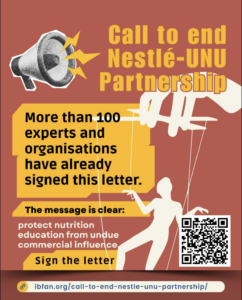
Story 1. Help stop Nestle Partnerships. An Open Letter signed by over 400 hundred academics, health-workers and campaigners has been sent to the Rector and Director of the United Nations University Institute for Water, Environment and Health (UNU-INWEH) calling for an end to their new “strategic partnership” with Nestlé. Please share the letter and add your signature if you agree. In November last year we wrote to and met staff from UNESCO calling on them to end a similar partnership. The letters highlight concerns about the lack of due diligence regarding conflicts of interest and how this undermines the integrity and independence of nutrition education and the credibility of United Nations-affiliated institutions.
Outrage over UN-Nestlé partnership
Lancet World Report Section, www.thelancet.com Vol 407 April 25th 2026
Story 2. Help stop Risky Codex labelling for emergencies
49th session of the Codex Labelling Committee
Ottawa, Canada, May 11-18th. IBFAN & ENCA submissions. IBFAN is concerned about a proposal by the USA calling for new guidelines to allow ‘flexibility’ for product labelling and ingredients during emergencies. IBFAN believes the guidelines are not needed and will do more harm than good, creating a double standard, that puts those in situations of food insecurity at even greater risk. We ask readers to contact government health and development representatives and make sure that they are aware of our concerns. IBFAN Codex rationale National Codex delegations can be found HERE.
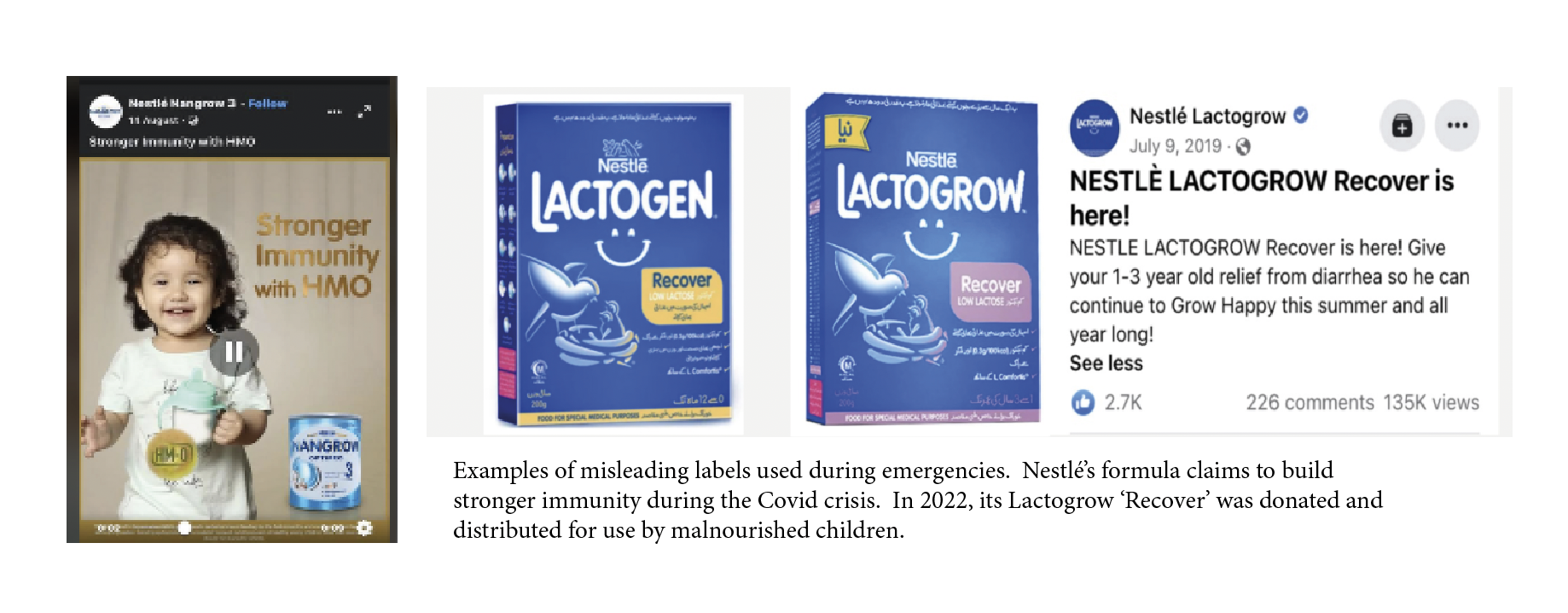
Story 3 Poorly regulated formula – a global health hazard
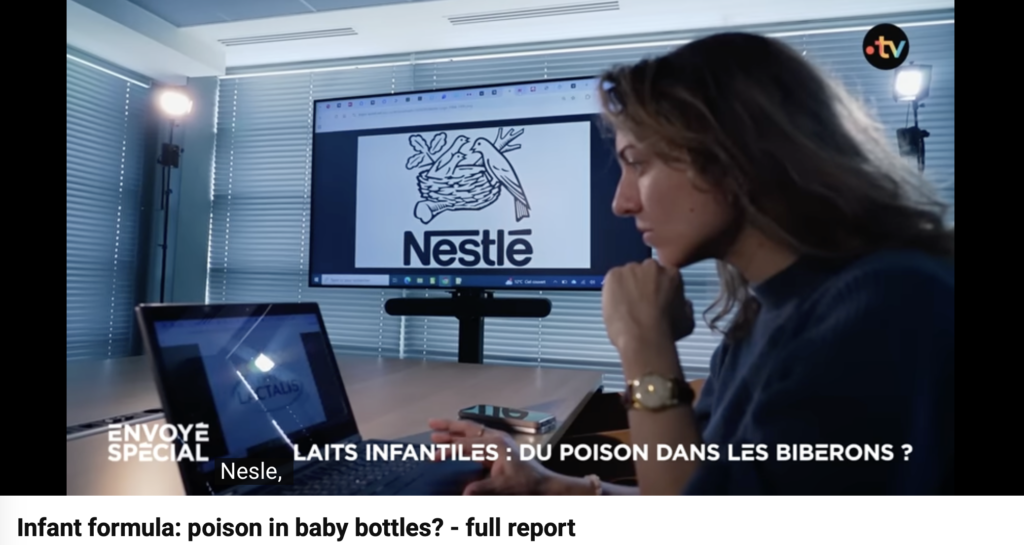
left: France Télévisions Report. 26/03/2026. Infant Formula: Poison in Baby Bottles?
includes parents of babies who suffered or died and who are struggling to find to find answers.
The infant botulism caused by contamination of Byheart formulas in November was followed in January 2026 with news of cereulide* contamination of Nestlé, Danone and other formulas. Formula has been exported to more than 100 countries; there are ongoing judicial inquiries into infant deaths in France and legal challenges about recall delays, lack of transparency, fraud and manslaughter. Because of the lack of transparency the real sequence of events is unclear, but cereulide contamination of formula occurred well before the recalls in Dec 2025. Meanwhile industry has obfuscated and claimed there is no evidence of a causal link between the illnesses and the formula. Nestlé passed any blame to external Chinese suppliers and still claims the recalls are “out of an abundance of caution.” Parents of children who fell sick or died have been left with denial,robotic answer-phone messages, limited treatment and poor access to recall information or support. Public trust in food systems has been destroyed.
In February, the French NATIONAL ASSEMBLY presented a Motion for a Resolution seeking the establishment of a committee of inquiry to assess the responsibility of multinational companies in cases of food contamination and the State’s strategy for anticipating and addressing such incidents. 3.2.26. National Assembly 2422 (English Deepl translation) “….Instead of communicating about health risks in accordance with the precautionary principle, multinationals are attempting to downplay the risks to the public. In France, on 13 January, Nestlé attempted to reassure its shareholders by apologising and claiming that no babies were ill. However, two criminal investigations have been launched in Bordeaux and Angers following the recent deaths of two infants who had consumed infant formula recalled by Nestlé. … All the facts mentioned should therefore lead Parliament to shed full light on the responsibility of multinational agri-food companies in the contaminated milk scandal, but also to exercise its role in overseeing the Government, as recent revelations raise fears of a lack of responsiveness to a public health risk.”
Story 4. IBFAN, ILCA, Burundi, Panama and Ecuador will be holding a Side Event during the 79th World Health Assembly in May to bring attention to the implications of the global trade of formula,especially when contaminated. As a global network, IBFAN focuses on the impact of this crisis not only on European families but on those in the Global South and in settings with restricted access to treatments. The voices of these parents is rarely acknowledged or heard. Our side event will call on Member States to safeguard all babies – those who are breastfed and those who are fed formulas. The implementation of WHO recommendations is an essential safeguard of course, but the food system and food culture needs to change. Governments have a responsibility to ensure that there is independent oversight that is free from commercial influence. Essential too that whistleblowers listened to and protected. (see Yasmine Motarjemi)
OFFICIAL ACTION: December 2025: IBFAN’s request to the Codex Food Hygiene Committee prompted the updating of Codex advice; February 26:WHO starts the updating of its risk assessments and scientific advice; EU Commission starts checking 50% of formula imports from China March: EU Parliament Hearing.see WHO Disease Outbreak Newsfor update on global action.
_______________________________________
*Nestlé’s infant, follow-on, pre-term and specialised formulas, were recalled because of possible contamination by cereulide – traced back to the optional ingredient arachidonic acid (ARA) Synthesised ARA made from funghi is added to justify premium prices and promote formulas as being ‘closer to breastmilk.’ There is no proof it that in formula it replicates breastmilk or improves outcomes. Breastmilk is a totally different living biological environment with co-enzymes that help fats to work optimally.
PICTURE: Mr Koen Van Dyke, from the European Commission’s DG Santé, answers questions from MEPs during the EU Parliament Hearing on cereulide contamination, March 24.2026.
Story 5 Abbott Laboratories fined $53M 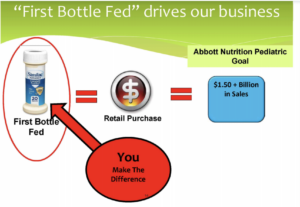 Law360, Chicago (April 9, 2026) A jury awarded $53 million in damages to four mothers claiming Abbott Laboratories concealed the risk of the illness associated with its formula from both the public and its regulators. The four babies contracted necrotizing enterocolitis (NEC) after being fed Abbott formula and have suffered long-term side effects. Thousands of similar cases are pending in state courts against Abbott and competitor Mead Johnson. Abbott’s expert witness, Dr. Jill Maron, a neonatal physician, testified that it would be “cruel” to discuss the risk of NEC with frightened mothers. Not only does her position make no sense, as doctors discuss scary risks with patients all the time, it buys into the “sexist trope” that women are too emotional to handle challenging facts, the judge said.
Nighttime is the right time to drive your business…This USA Today article (March 2025) gives an inside view of the competition between formula companies that driving their unethical marketing:
- Abbott’s goal was that the first-bottle-fed strategy would help generate more than $1.5 billion in sales,
- Behind their warm-and-fuzzy marketing, industry giants Abbott, maker of Similac products, and Mead Johnson, maker of the Enfamil line, have turned neonatal intensive care units into arenas of brutal competition.
- One Abbott document shown in the Whitfield trial said more than half of first feedings happen at night, adding, “Nighttime is the right time to drive your business.”
_________________________________________
“Those who, for instance, make claims about infant formula that intentionally undermine women’s confidence in breastfeeding are not to be regarded as clever entrepreneurs just doing their job, but as human rights violators of the worst kind.” Stephen Lewis, Montreal International Nutrition Congress, 1996. A champion of Human Rights, he died March 31st, aged 88. .
_____________________________________
News Update February 10th 2026
WHO SPEEDS UP ACTION ON CONTAMINATION OF COMMERCIAL FORMULAS
WHO 158th Executive Board (EB). 2-7th February, 2026, WHO HQ Geneva.
In response to calls from governments, IBFAN, ILCA and health advocates about the recent crisis of contaminated commercial formulas, WHO and the Food and Agriculture Organisation (FAO) have begun the process to update their risk assessments and scientific advice (1) Now nearly 20 years old this advice is not adequate to prevent contamination with spore-forming pathogens and bacterial toxins at the centre of the Nestlé (2) and ByHeart (3) outbreaks in the last three months. Nestlé’s recall from over 60 countries in January is described as the biggest in the history of the company and the baby food industry is now said to be in crisis, with judicial inquiries into the deaths of babies in France, legal challenge for damages in the UK and a Lawsuit in France about Nestlé’s recall delays and lack of transparency. CLICK HERE for more and HERE for media. One page summary
__________________________________________________________________
IBFAN WEBINAR WEDNESDAY 21 JANUARY 2026.
 CLICK HERE Serious Food Safety Failings expose global health risks of unregulated online cross-border promotion.
Yasmine apologises that her presentation is a little rushed, also that in her description of the complexity of the food supply chain, the multitude of hazards and unpredictability of fraud, she used a French word that implies that incidents are ‘inevitable.’ She meant to say‘unavoidable.’ Here are the slides:
The tale of three infant formula crises. Presentation by Yasmine Motarjemi, 21.1.26
Is Powdered Formula Safe? Presentation by Elisabeth Sterken
Food safety risks of self-regulation and online cross-border promotion. Presentation by Patti Rundall
- Yasmine Motarjemi, formerly WHO’s Food Safety Senior Officer (1990-2000) and Nestlé’s Global Director of Food Safety and Assistant Vice-President (2000 to 2010). Yasmine explain how she was forced to leave her job after repeatedly raising concerns about Nestlé’s mismanagement of food safety. All the time she was in post at Nestlé, her department of food quality, the cockpit of the Company,was never inspected by government authorities, not even when food incidents occurred. She refused to be silenced and became a whistleblower. (Slides 2026)
- Elisabeth Sterken, INFACT Canada, IBFAN Global Council and Coordinator of IBFAN’s Codex team. (E.Sterken Presentation)
- Lynn Moeng Mahlangu, IBFAN AFRICA TECHNICAL Director, former Head of Health Promotion and Nutrition in South African Ministry of Health.
- Patti Rundall, IBFAN Global Council. Presentation
- Nigel Rollins, Professor, Queen’s University, Belfast. Formerly WHO Maternal Child Health
________________________________________________________________
News Update January 12th 2026.
Nestlé’s credibility questioned over formula recall in 60+ countries
- 5th January Nestlé’s recall of batches of infant, follow-on, pre-term and specialised formulas because of possible contamination by cereulide – Bacillus cereus
- Nestlé’s biggest recall yet.
- ByHeart and Nestlé outbreaks expose systemic failures in formula production, regulatory surveillance, transparency and crisis communication.
- Nestlé claims no confirmed illness and recall is done “out of an abundance of caution,” ignoring parents reports on its own SMA Facebook page.
- Nestlé fails to name Cabio Biotech, (a Chinese company based in Wuhan) who supplied the arachidonic acid (ARA), supposedly the source of the contamination.
- IBFAN calls for an urgent revision of the 2009 Code of Hygienic Practice at the Codex Committee on Food Hygiene and 2007 WHO Guidelines on the Safe preparation, storage and handling of powdered infant formula.
- IBFAN demands that independent auditing of food (and other safety) systems by government authorities.
- Idealising promotion and cross border online marketing and sales exacerbate food safety problems – especially in Global South.
- Whistleblower Yasmine Motarjemi was WHO’s Food Safety Senior Officer (1990-2000) and Global Director of Food Safety at Nestlé and Assistant Vice-President (2000 to 2010). Forced out of her job after repeatedly raising concerns about Nestlé’s mismanagement of food safety. Her department of food quality was never inspected by government authorities.
- UNICEF’s new digital toolkit and Model Legal Language for protecting children from unhealthy and ultra-processed food marketing is now live
-
Two new studies exploring women’s experience of breastfeeding
India and the UK
___________________________
Mailings 2025
News Update. December 2025
- ByHeart&Botulism: serious food safety failing expose online marketing risks Capitalising on President Trump and Secretary Kennedy’s Make America Healthy Again agenda, the new US company ByHeart has been promoting its infant formulas direct to consumers via global platforms such as Amazon, claiming its products are purer, healthier, “filled with ingredients backed by breast milk science in every scoop” that have undergone ‘rigorous testing going above and beyond what is required.’ It’s no wonder that ByHeart’s formula market has grown fast in the USA and spread to Canada, Africa, the Arab world, Asia and Latin America. The ByHeart story is a lesson in deception. The U.S. Food and Drug Administration (FDA) has investigated ByHeart factories since its launch in 2022 and has found multiple safety violations, leaking roof, mold in a water tank, 2,500 dead flies – enough to raise an Official Action Indicated (OAI) red flag, the FDA’s highest tier of concern.
- UK Government response to CMA, Action on misleading promotion still delayed
- Danone sponsored side event – Labour Party Conference, September 25
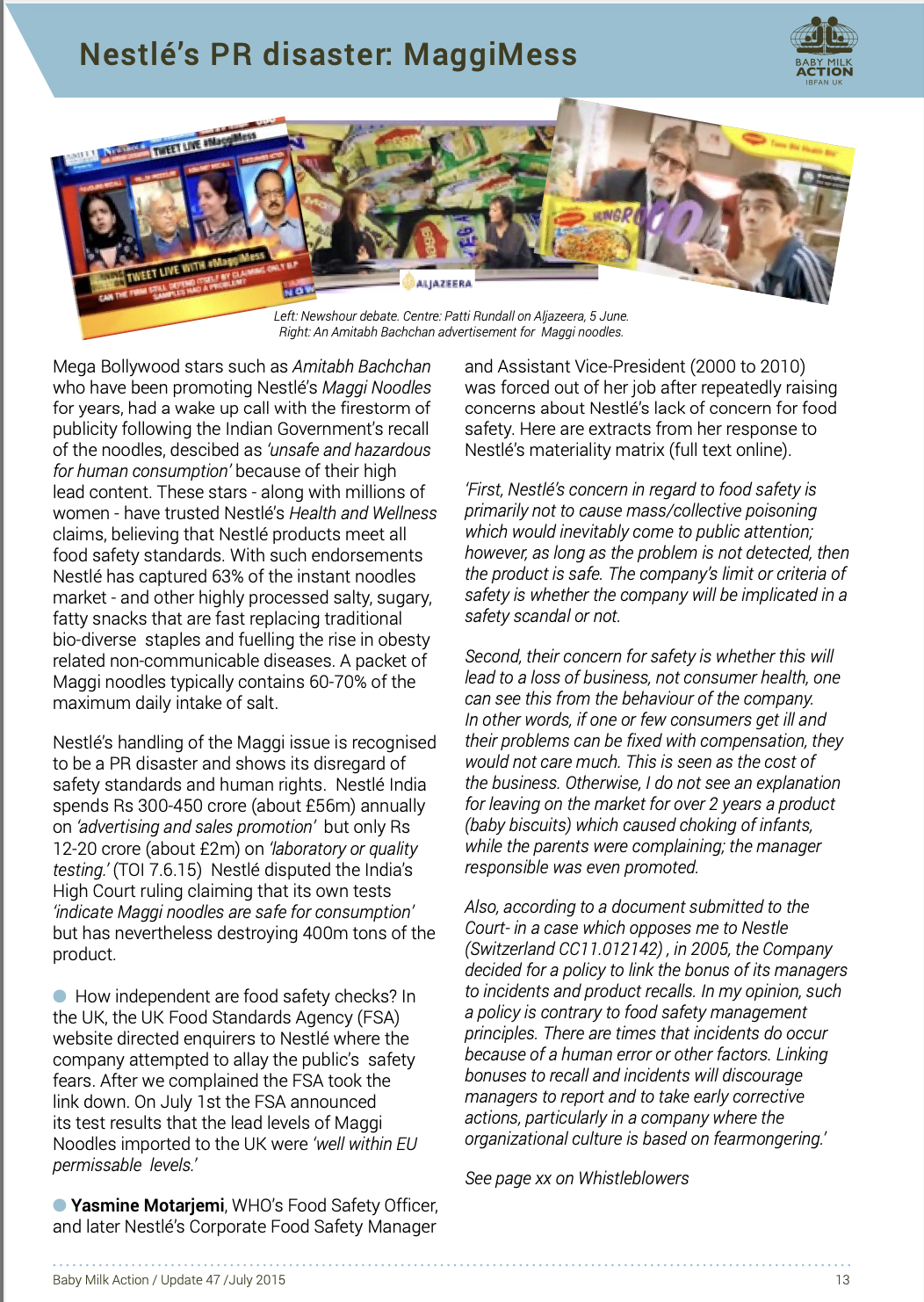
- Public Eye expose Nestlé’s double standards on sugar and its marketing in the Eastern Cape
- IBFAN’s Statement ‘Nestlé Water Scandals’
- Lancet, WHO, UNICEF and Codex all tackle UPFs at last
- WHO and UNICEF brief on Global Nutrition Targets 2030
- Unmasking Influence – how corporations influence policy and public health FILM TRAILER
- Farewell to IBFAN’s Adriano Cattaneo, and UNICEF’s Grainne Moloney
_________________________________________
June 24.2025. WHA Resolution on Digital Marketing, UK families let down by weak legislation
Monday June 22, 2025. News Update: UK and International MISLEADING MARKETING AND OVERPRICED MILK: HOW BABY FORMULA COMPANIES ARE EXPLOITING PARENTS – AND GETTING AWAY WITH IT.
Fri, Jan 17, 2025. Digital marketing resolution, Tesco abandons ‘milk nurses’, ‘Humanitarian’ donation exploitation
__________________________________________________________–
2024:
2.12.24 Plastic Treaty fails: Can Codex prioritise human and planetary health?
(see Blog HERE). IBFAN interventions at CAC 47 – Video clips
While the Global Plastics Treaty failed to reach consensus in Busan, Republic of Korea, the Codex Alimentarius Commission, the WHO/FAO global food standards setting body, ended its meeting in Geneva, with several countries, including from South East Asia, still asking for standards that would help them promote plastic-wrapped, synthetic, additive-laden ultra-processed products (UPFs) that replace the traditional bio-diverse foods that humans have eaten for millennia.(1)

|


25.11.24. Codex risks exploitation of emergencies & dithers on sugar, Danone Milk Nurses in the high St

- Codex debates its future direction – but opens the door to risky labelling in foods for emergencies;
- Tesco and Danone Milk Nurses in UK High Street;
- Competition and Markets Authority to decide on formula marketings and Greedflation
- Impact of sugar rationing in World War II – Codex dithers
- 8 Countries table a Digital Marketing Resolution for WHA78 2025
- Health and Environmental Impacts – Plastics Treaty
Codex 26th October 2024 Will Codex open the door to exploitation of food aid in emergencies and more greenwashing? IBFAN protects the right to privacy in e-commerce


20th October 2024. Tigers: 10 years on, corporations still risk child health & survival.

EU and Switzerland try to tackle sweetness – the UK wary of ‘probiotic’ claims, Codex starts new work on baby foods 5 October 2024
Quick Update 2 September 2024.
Quick update (with correct links!)
News roundup 6 August 2024 News Update: Nestlé’s Double Standards, Digital Marketing

Petition launch April and Delivery October 2024

Brazil Resolution February 2024

__________________________________________________________-
UD49 September 2020 Top stories:
- Industry exploitation of COVID
- When SUN casts a Shadow
- Multistakeholderism
- ‘BMS Call to Action’ gives companies a 10-year licence to harm children
- Astro-turfing
- Codex and Ultra processing


Update 48 – April 2017


UD 47 – May 2016.

UD 47 – May 2016.
Top stories in Update 47:
Tigers – Whistle blower movie
RCPCH votes to end formula funding
EU Parliament votes to lower sugar in baby foods
Corporate capture of WHO
50 years of Nestlé
 Update 46 – March 2014
Helping Filipino mothers after the Typhoon (p18)
EU Diet Platform & Action Plan calls for no sponsorship in schools(p6&7)
IBFAN in Official Relations with WHO
UPDATE 45, May 2013.

Top Stories:
Nestlé and Pepsi’s Crusade in Mexico (page 6&7)
Strong laws enacted in three countries
Industry threatens Philippines and Kenya
World Breastfeeding Trends plots path to success
Nestlé formula seized for breaking Indian law

Update 42 (November 2009) to Update 45 (May 2013) on the previous version of this website.
UD19 August 1996 Page 3 – adoption of WHA Resolution 49.15, the first WHA Resolution to call for Conflict of Interest safeguards.)


Update 18 (March 1996) to Update 41 (November 2008) on our archive website.
UD 14 1994 P6. Consensus on the Code

The Resolution to control Digital Marketing: Click here and HERE
Link to our side event with presentations from WHO, UNICEF, IBFAN, Save the Children as well as Brazil, Mexico, Lesotho, Kenya and Bangladesh. Important new UNICEF guidance UNICEF has launched an excellent new guidance entitled: Countering Industry Arguments Against Code Implementation: Evidence and Rights-Based Responses.
We are a founder member of the multi-agency Infant feeding in Emergencies Core Group, that was set up in 1999 to address policy gaps in infant and young child feeding support in emergencies. The IFE has many important resources and at the last quarterly meeting we were shown two new films that stress the importance of breastfeeding in emergencies and the risks of unsolicited donations of formula. Here are the links Breastmilk is A Lifeline during Disastersand this one The Story of untargeted infant formula donations