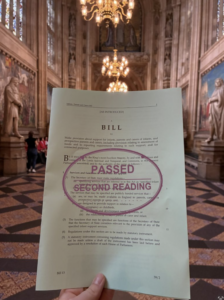
 The Infants, Parents and Carers Bill (“the Babies Bill”) – passed its Second Reading and will now progress to Committee Stage
10 am, Friday 4 September 2026.
HANSARD record of the 4 hour debate today, 4th September
This was a wide ranging debate focusing on the importance of a legal obligation to provide adequate services to parents. Many speakers highlighted the loss of the Sure Start centres in 2010, whose importance is universally acknowledged. Several interventions mentioned breastfeeding, the impact of marketing and the need for Conflicts of Interest safeguards.
Some excerpts from the Hansard record of the Debate (apologies not in the right order)
Rt Hon Sir Desmond Swayne, Conservative MP for New Forest West, led the 4 hour Second Reading of the Infants, Parents and Carers Bill (“the Babies Bill”) and like many of the speakers, stressed the importance of: “…the early weeks, months and years when 1 million neural networks are being formed every second and the baby’s brain grows to 80% of the weight of an adult’s brain by two years old”.
12.48pm Iqbal Mohamed (Dewsbury and Batley) (Ind) Before I talk about my constituency and some of the challenges that it faces, let me pick up the point about breastfeeding. It is absolutely the right of the mother to choose, and sometimes it may not be possible for that mother to breastfeed. However, it is important that substitute breast milk is not commercialised and sold for immense profit in this country or elsewhere. Parents, especially those in low-income households, struggle to make ends meet as it is. The children of mothers who, for whatever reason—medical or other—are unable to breastfeed depend on substitute breast milk. That must not become the cost that suddenly unravels the household—not just for the child, but for everybody living in it.
Jess Brown-Fuller (Chichester) (LD) I thank the hon. Gentleman for raising an important point: the formula industry is a commercial industry. Breast milk, by its very nature, is free and therefore does not have the backing of large-scale corporations that advertise it widely. Does he agree, then, that the Government should heed the Competition and Markets Authority’s report into the formula milk industry and take on its recommendations, including price controls for formula milk?
Iqbal MohamedI wholeheartedly agree with the hon. Lady. It is important for parents, mothers and families to know that Government policy is free from commercial influence, not just in this space but in all the spaces that impact our citizens. As an engineer and a regulatory compliance expert in the pharmaceutical industry, I believe that the marketing of breast milk and the formulation of breast milk need to be better regulated. The Medicines and Healthcare products Regulatory Agency should have responsibility to regulate the nutritional content of substitute breast milk and the marketing claims of substitute breast milk producers. That is an important measure that the Government could introduce to ensure the consistent quality and nutritiousness of substitute breast milk. The Babies Bill aims to place support for babies, parents and carers during the first 1,001 days on a stronger statutory footing and create greater accountability for ensuring these services are available in England and Wales.
10.36 Munira Wilson(Twickenham) (LD) “….As others have already said, we know that a person’s quality of life and outcomes are profoundly shaped by those early months and years. People have talked about the rapid brain development; the first 1,001 days lay the foundations for a child’s development, including attachment, emotional regulation, language and lifelong physical and mental health. As we have heard, babies are entirely reliant on the adults around them to protect and nurture them. Again, that is why I was shocked to read in the NSPCC briefing that 61% of child deaths happen in babies under the age of one. That is profoundly shocking. It underscores the importance of the support that we provide to parents and carers, ensuring that people are going into people’s homes to see what is going on, as the Chair of the Treasury Committee, the hon. Member for Hackney South and Shoreditch (Dame Meg Hillier), has said.
Issues that we asked MPs to support:
- the importance of independent, evidence-based infant feeding information and support, free from commercial influence;
- the need to recognise that babies have distinct nutritional, developmental and care needs that should be reflected across policy and public services;
- ensuring resilience and food security planning protects infant feeding and meets the needs of babies, mothers and families.
These priorities are supported by a strong evidence base, including the 2023 Lancet Breastfeeding Series, which highlights the importance of protecting families from commercial influence. As I’ve mentioned several times before, bringing the current UK marketing laws fully into line with the World Health Assembly recommendations (the International Code of Marketing of Breastmilk Substitutes and subsequent WHA Resolutions) and ensuring these laws are adequately monitored and enforced will protect all children and their families – those who breastfeed and those who are not.
- Yvette Cooper MP – Secretary of State for Health and Social Care
- Dame Diana Johnson MP – Minister of State for Public Health and Patient Safety
- Alison McGovern MP – Minister of State for Social Care
- Karin Smyth MP – Minister of State for Health (Secondary Care) [1]
____________________________________________
IBFAN’s call to improve Codex standards and stop fraudulent marketing
In October, Codex will meet to discuss imports and exports and Food Fraud. IBFAN is highlighting predatory marketing and fraudulent claims on baby foods. In November Codex will also discuss a new standard for baby foods as well as contaminants.
What impact does Code regulation have on breastfeeding?
IBFAN partners WHO and UNICEF in the production of the biennial reports on the global progress in Code implementation. The latest report, To see examples of how parents are misled by fraudulent marketing claims Marketing of breast-milk substitutes: national implementation of the International Code, status report 2026 includes analyses that demonstrate a clear association between legislative strength and breastfeeding practices. Countries substantially aligned with the Code report exclusive breastfeeding rates of 54%, compared with 24% in countries with no legal measures. While early initiation of breastfeeding shows no strong correlation with Code alignment, provisions addressing industry engagement with health workers and health systems appear to yield measurable improvement on this practice. Continued breastfeeding at 1 year of age reaches 81% in substantially aligned countries but only 44% in countries without legislation. A similar gradient is observed at 2 years (55% vs. 22%).