
Risky Codex labelling guidelines adopted
Codex Commission (CAC49) Geneva, 6-10th July
The 49th Codex Alimentarius Commission met in Geneva this last week and among other issues, adopted new labelling Guidelines for foods for emergencies proposed by the United States. IBFAN has been concerned about the guidelines from the start, worried that they could open the door to double standards: the dumping of sub-standard products, risky unclear labelling and exploitation of the most vulnerable.
Several governments and NGOs shared our worries and, as a consequence, some ‘high level’ safeguards were added during the Code Labelling Committee (CCFL) in May. But in relation to the labelling and composition of formulas and foods for infants and young children there are serious omissions that we feel sure will be explored by the baby feeding industry.
WHO, IBFAN, ENCA ILCA, NCDAlliance RTSL WPHNA, NFH and Cabo Verde called for further strengthening: for formulas and foods for infants and young children to be excluded and the Code of Ethics for International Trade in Food to be clearly reflected. This Code contains many important food safety and labelling principles and Article 4.4 refers to the International Code of Marketing of Breast-milk Substitutes and WHA Resolutions.)
Cabo Verde, a Small Island Developing State and a net food-importing country, said “the text is not fully ready for adoption in its current form and should be strengthened before adoption by CAC49….Cabo Verde further considers that infant formula and foods intended for infants and young children should not be subject to emergency labelling flexibility that may affect mandatory information related to health and safety, preparation, composition and traceability, given the vulnerability of this population group.”
One major concern is that the Guidelines rely on ‘Competent Authorities’(1) in all countries having good emergency preparedness plans in place with staff able to recognise and disallow inadequate labelling. Since such systems are often missing the Guidelines are likely to open the door to double standards and with the most vulnerable populations exposed to unacceptable risks.
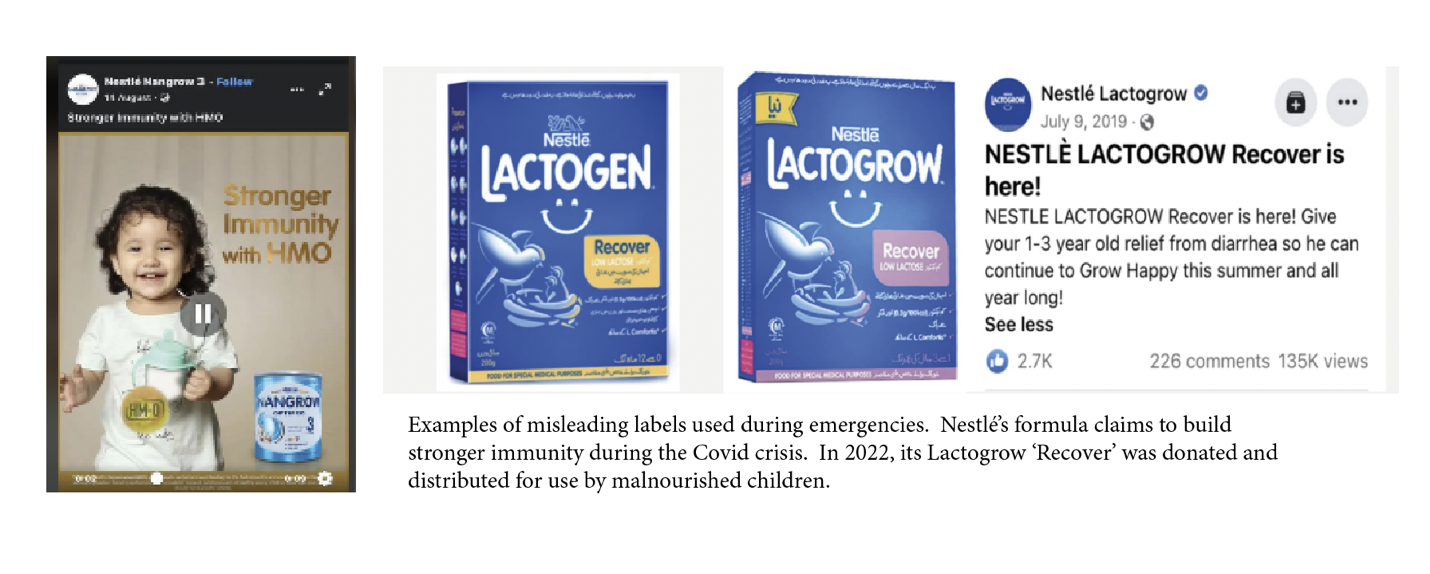
Why it is risky to have weak labels on baby foods: During emergencies child deaths can be two to 70 times higher than the average rate. The risks of not breastfeeding during the first six months are greatly increased when water and sanitation are scarce and basic hygiene breaks down. All mothers have the right to decide how to feed their children so there will be a need for carefully managed formula for babies who are not breastfed. But uncontrolled donations are a lethal risk that are made even worse when labels are idealised, in the wrong language and when warnings are missing. (see below) This is why full implementation of the marketing recommendations of the World Health Assembly, the International Code and subsequent WHA Resolutions are essential. The USA, a country that has failed to implement these recommendations and has now officially left WHO, dominated the labelling discussions (CCFL49) and the CAC49, trying to eliminate any text that might be difficult for the baby food industry.(2)
____________________________________________________
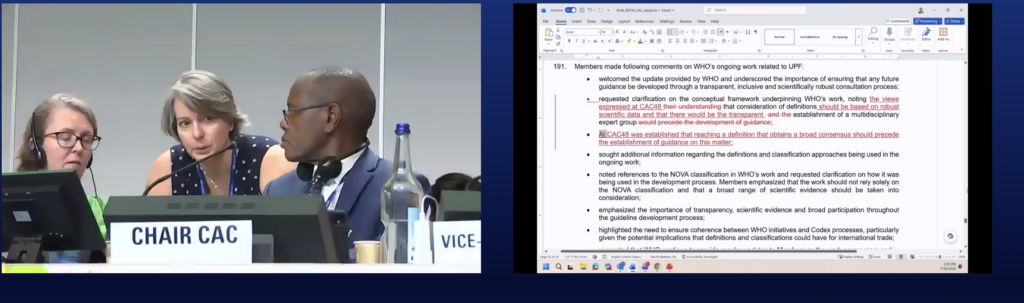
Codex Secretary, Sarah Cahill, Dr Simone Moraes Raza, WHO and Allan Azegele, Codex Chair, discuss Report text relating to UPFs
At the conclusion of the CAC49 debate, the Canadian CCFL chair, Dr Parthi Muthukumarasamy, summed up the safeguards, that he believed would protect vulnerable populations from misuse. He explained that the guidelines
-
- did not mandate flexibilities, but would guide competent authorities where they consider flexibilities during an emergency, while prioritizing consumer health and fair practices in the food trade;
- should only be used by competent authorities and were not for use by third parties;
- any emergency food-labelling flexibilities should be temporary, justified, proportionate, risk-based, and authorized by competent authorities;
- flexibilities should not compromise food safety and were there to protect a safe and adequate food supply during emergencies;
We intervened to say there was no evidence to support his final statement that:
-
- the proposed flexibilities did not introduce any food safety risks for vulnerable populations, including infants, young children, and persons with special dietary needs, Section 3.1.11.
2026 Calendar

Patti Rundall, IBFAN, Alice Jose Rodreigues, Nutrition Regulation, Cabo Verde and Scott Tips, National Health Federation
| Codex Committee on Pesticide Residues (CCPR57) | 7 – 12 Sept | Beijing, China |
| Codex Coordinating Committee for Europe (CCEURO34) | 21 – 25 Sept | Berlin, Germany |
| Codex Committee on Food Import and Export Inspection and Certification Systems (CCFICS28) | 12 – 17 Oct | Perth, Australia |
| Codex Committee on Contaminants in Food (CCCF19) | 19 – 23 Oct | Cairo, Egypt |
| Codex Committee on Nutrition and Food for Special Dietary Uses (CCNFSDU45) | 2 – 6 Nov | Nuremburg, Germany |
| Codex Committee on Food Hygiene | 16 – 20 Nov | Arizona, USA |
For the most up-to-date schedule see the Codex calendar
(1) Codex Alimentarius has mandate to both protect health and facilitate fair trade and its texts often serve as the basis for national food legislation and can be used as the benchmark in trade disputes.
(2) For agencies and NGOs working in emergency relief, flexible labelling can complicate the traceability and recall procedures of contaminated or unsafe food. Formula contaminated with Cereulide was exported to Ukraine, the Gaza Strip and West Bank.
(3) The latest WHO/UNICEF/IBFAN status report: Marketing of breast-milk substitutes: national implementation of the International Code, 2026 shows a clear association between legislative strength and breastfeeding practices. Countries substantially aligned with the Code report exclusive breastfeeding rates of 54%, compared with 24% in countries with no legal measures.
(4) According to 31st Codex Procedural Manual“Competent authority” means the official authority charged by the government with the control of food safety, food hygiene, food standards and related legislation. During the Codex Hygeine Meeting in December 2025. Report:
- An Observer (Patti Rundall – representing ENCA] reiterated their view shared at CCFH55 that in the revised CXG 78-2011, trade associations should not be included among the competent bodies authorized to undertake specific verification activities in relation to the industry’s process control systems as this could result in industry verifying its own compliance. It was emphasized that verification should be conducted by government authorities to ensure credibility. The Observer also reiterated concerns raised at CCFH55 about contamination of powdered infant formula noting recent recalls. [Deleted at the request of the USA: had impacted over 130 countries.]
“With 117.8 million people forced to flee their homes, facing food insecurity and scarce water and sanitation, allowing weaker product labelling – especially for formulas and baby products – is an unacceptable contradiction of human rights principles.”
CAC49 will be webcast in Arabic, Chinese, English, French, Russian and Spanish. Language options can be selected in the video player. The General Public and those who just wish to listen to the discussions are encouraged to follow the webcast. Links are here available:
Day 1 AM – Day 1 PM
Day 2 AM – Day 2 PM
Day 3 AM – Day 3 PM
Side Events AM
Side Events PM
IBFAN concerns about Codex:
The lack of transparency and poor conflict of interest safeguards, coupled with the dominance of food corporations and powerful exporting nations, has led to Codex adopting weak standards for many harmful foods and commodities. For many years IBFAN has advocated that for-profit industries should not sit on Government Codex delegations, as they regularly do. Kelly Weeks Manager of Abbott Nutrition, a major US baby food and pharmaceutical company sat on the US Labelling Committee delegation.
Codex standards have been regularly used in attempts to stop governments bringing in strong marketing controls. with interventions made at the WTO concerning commercial milk formula marketing, labelling or safety testing regulations of another member state, wrongly treating Codex standards as a ‘regulatory ceiling’ for trade purposes. In fact, governments have the sovereign right to adopt any legislation they consider necessary to protect child health as long as it does not violate international trade principles,
CAC49/CRD13 Cabo Verde CRD13
Guidelines on the Application of Food Labelling Provisions in Emergencies
Cabo Verde thanks the Codex Secretariat for the opportunity to comment on CL 2026/48-CAC.
With regard to the Guidelines on the Application of Food Labelling Provisions in Emergencies, Cabo Verde recognizes their importance in supporting competent authorities and food supply continuity during crises. However, Cabo Verde considers that the text is not fully ready for adoption in its current form and should be strengthened before adoption by CAC49.
Any flexibility in emergency situations should be strictly limited, risk-based, temporary and authorized by the competent authority. Such flexibility should never compromise essential health and safety information, including allergen information, ingredient lists, preparation instructions, lot identification and traceability elements.
Cabo Verde further considers that infant formula and foods intended for infants and young children should not be subject to emergency labelling flexibility that may affect mandatory information related to health and safety, preparation, composition and traceability, given the vulnerability of this population group.
The Guidelines should also remain consistent with relevant Codex texts and public health safeguards applicable to international food trade, including food aid and concessional transactions, in particular the General Principles of Food Hygiene (CXC 1-1969) and the Code of Ethics for International Trade in Food (CXC 20-1979), where applicable.