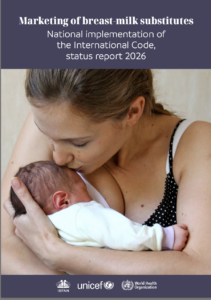
The latest WHO/UNICEF/IBFAN status report clearly shows how strong implementation of WHO recommendations increases breastfeeding rates.
How Code legislation impacts. breastfeeding rates
Analysis of infant and young child feeding (IYCF) outcomes demonstrates a clear association between legislative strength and breastfeeding practices. Countries substantially aligned with the Code report exclusive breastfeeding rates of 54%, compared with 24% in countries with no legal measures. While early initiation of breastfeeding shows no strong correlation with Code alignment, provisions addressing industry engagement with health workers and health systems appear to yield measurable improvement on this practice. Continued breastfeeding at 1 year of age reaches 81% in substantially aligned countries but only 44% in countries without legislation. A similar gradient is observed at 2 years (55% vs. 22%). Full inclusion of provisions on promotion to the general public, informational and educational materials on IYCF, and labelling stand out as the sections of the Code with the greatest impact on continued breastfeeding.
WHO Abstract: Inappropriate marketing of breast-milk substitutes remains a significant public health concern, with implications for breastfeeding practices and maternal and child health outcomes. This status report presents a global assessment of the extent to which countries have implemented the International Code of Marketing of Breast-milk Substitutes and subsequent World Health Assembly resolutions through national legal measures. It examines legislative progress, scope and content of existing laws, and the degree of alignment with Code provisions across WHO Member States . Drawing on standardized analysis of legal frameworks from 194 countries, the report describes patterns in adoption, identifies persistent regulatory gaps, and reviews provisions related to promotion, labelling, health system safeguards, and monitoring and enforcement. It also outlines global and regional efforts to support implementation, including technical assistance and capacity-building initiatives. The analysis explores the relationship between legislative strength and breastfeeding practices, highlighting associations between stronger legal alignment and improved rates of exclusive and continued breastfeeding. The findings are intended to inform policy-makers and stakeholders involved in nutrition, maternal and child health, and regulatory governance.
https://iris.who.int/items/7fd05813-e7f8-46d8-9c29-70fce8ea5ab7
Download the report: 9789240122758-eng.pdf (4.54 MB)