
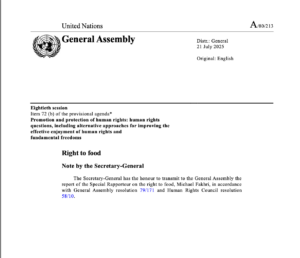
Corporate Power and Human Rights in Food Systems.
The final report of the United Nations Special Rapporteur on the Right to Food, Mr. Michael Fakhri will be presented to the UN General Assembly on 17 October 2025.
There are many language versions HERE
Corporate power in food systems is highly concentrated, allowing a relatively small group of people to shape food systems in a way that serves the ultimate goal of profit maximization instead of the public good. In the present report, the Special Rapporteur examines how a relatively small number of corporations have amassed so much power over our food systems and outlines what is to be done to: curtail corporate power; ensure food markets are fair and stable; and hold corporations accountable for human rights violations in food systems.
Some excerpts:
17. Most alarming is the disproportionate targeting of children. Food and beverage marketing is pervasive, with the majority of food types marketed to children as part of an approach aimed at influencing their preferences, requests, purchases and eating behaviours, and increasing the risk of childhood obesity. Relatedly, despite the prohibition on advertising and other forms of breast-milk substitutes, some industry tactics include marketing practices that spreading false health and nutrition claims, the cross-promotion of milks and associated brands for infants, toddlers, older children and adults, as well as lobbying and the use of trade associations and front groups.25
VI. Conclusions and recommendations
76. From a human rights perspective, high levels of corporate concentration and power in food systems undermines people’s agency and autonomy, understood as their ability to make choices and meaningfully participate in food systems. Corporate power limits the ability of individuals to gain access to the resources necessary to make food available, such as land, water and agricultural inputs. It also limits their access to adequate food because of corporate-created inflation or the dominance of supermarkets. Corporate power disrupts local and territorial markets, pushing more people to depend on unstable global markets and complex supply chains. Corporate food systems tend to produce food that is not culturally, nutritionally or environmentally adequate. Corporate food systems also exacerbate structural inequalities, disproportionately affecting those who already face systemic barriers to food access.
77. The fast-moving digital revolution in food systems will cause more harm than good, in the absence of appropriate regulation. The world does not need more data or more food – people instead need more power and control over data in food systems.
78. Corporations are profiting from oppression, exploitation and occupation in food systems, thereby producing violence and inequality.94 The problems of the world’s food systems stem from a political economic system that allows corporations to financially benefit from violating people’s human rights – even allowing corporations to profit from genocide.95
79. The Special Rapporteur was heartened by the significant number of submissions from States and civil society organizations in response to his call for inputs, highlighting food systems that prioritize care for people and nature, whether through agroecological practices or enterprises, organizations and other entities forming a social and solidarity economy.96 This is a political economy engaged in economic, social and environmental activities to serve the common good, which are based on the principles of voluntary cooperation and mutual aid, democratic and/or participatory governance, autonomy and independence. They provided examples of sustainable food practices that prioritized people and social purpose over capital in the distribution and use of assets, surpluses and profits.
80. States must at least protect people’s rights from corporate power and ensure that people have access to effective remedy. Corporations must at least respect people’s human rights.97 For many corporate actors, a key incentive to uphold practices that respect human rights is the risk of reputational damage arising from their involvement in human rights violations and international crimes. Where direct remedies are not available against corporate entities, it may be possible to hold States responsible for failing to comply with their obligations vis-à-vis corporate entities within their jurisdiction.
81. The Special Rapporteur recommends that States:
(a) Prioritize their focus on using corporate law to change the internal incentives within corporations to align with respecting, protecting and fulfilling human rights. It is very difficult to curtail corporate power or hold corporations accountable unless corporations are changed from within.98 If States provide a clear, predictable human rights environment through corporate law, this could create a “race to the top” and attract businesses that understand the long-term benefits of a human rights-friendly economy and the market stability it creates. Many businesspeople want to do the right thing and contribute to enhancing people’s human rights. Food corporations incorporated in human rights-friendly jurisdictions would likely attract more consumers;
(b) Use all legal tools available in commercial law to curtail corporate power, such as competition law, tax law and investment law;
(c) Use all legal tools available to hold corporations accountable, especially through national and international criminal law;
(d) Commit to finalizing negotiations on the proposed international legally binding instrument to regulate the activities of transnational corporations and other business enterprises and on the proposed international tax treaty in a way that recognizes and realizes all human rights;
(e) Recall that corporations do business in food systems as a privilege and not a right. Therefore, home States should revoke corporate charters in cases of serious violations of human rights and host States should ban corporations that seriously violate human rights;
(f) Support peasants, pastoralists, fisherfolk, Indigenous Peoples, women and workers in food systems;
(g) Support agroecology, social and solidarity economies and economies of care;
- (h) Implement specific measures such as the following:
- (i) Effective front-of-package labelling;
- (ii) Restrictions on the marketing of unhealthy food;
- (iii) Taxes on unhealthy food and beverages;
- (iv) Removal of subsidies for unhealthy food and introduction of subsidies for healthy foods;
- (v) Provide universal school meals along with public procurement policies that are committed to sourcing from local, small-scale producers and Indigenous Peoples;
- (vi) Mandatory regulations on the nutritional composition of processed foods;
- (vii) Laws implementing the International Code of Marketing of Breast- milk Substitutes, and the World Health Organization guidance on ending the inappropriate promotion of foods for infants and young children;
- (viii) Domestic laws to implement international labour laws that protect food and agricultural workers across the entire food system;
- (ix) Prioritize the voice of rights holders over corporations within the United Nations and national Governments to ensure that profit-making motives do not dominate international and national governance.