Please note: THIS PAGE IS NOT KEPT UP TO DATE
Why the Nestlé boycott continues
Nestlé, the world’s largest food and beverage company, has been the subject of fierce criticism and consumer boycotts for decades for its poor health, ethical and environmental actions.
Since the 1970s IBFAN has been at the forefront of criticism of Nestlé and the coordinator of an International Boycott, because of its aggressive marketing of baby foods in breach of the International Code of Marketing of Breastmilk Substitutes and the 20 World Health Assembly Resolutions. Nestlé’s marketing continues to be a serious threat to infant and young child health and survival.
Since then Nestlé has come under attack for many other aspects of its business: the poor quality and safety of its 2000 brand food portfolio (50-70% of which is deemed to be unhealthy); its labour standards (with ongoing charges of child slavery); and its impact on the environment (water extraction, plastic pollution, intensive agriculture, risky technologies. mono-cropping and land-grabbing…)
Baby Milk Action is the UK member of the global network IBFAN, with over 300 groups in 100 countries. IBFAN has been protecting children for over 45 years – monitoring companies and helping governments bring in legislation that stops the predatory marketing that all companies do. 144 countries (70%) have brought in legislation based on the Code – but because of pressure from companies many of these laws have loopholes that allow harmful marketing to continue. Nestlé, the oldest and largest manufacturer and distributor of baby foods pretends to be Code complaint, yet in all the independent monitoring reports it is found to violate the Code the most – closely followed by Danone. Nestlé uses its power and wealth to influence policies in their favour.
How you can help:
The boycott is just one part of Baby Milk Action’s strategy to hold the baby food industry to account. Follow these links to see how we help bring national and global policies into line with WHO recommendations:
Policy Basics Conflicts of Interest Global Monitoring Policy Blog. You can help this work further by becoming a member of Baby Milk Action. If you are outside the UK, contact our partners in the International Baby Food Action Network (IBFAN).
Could you the movie Tigers? to your friends. Tigers is a feature film by Oscar winning Director, Danis Tanovic, based on the true story of former Nestle Pakistan salesman who takes on the baby milk industry with the help of IBFAN.
If you would like a link to the film can please send a DONATION hereand a request to: prundall@babymilkaction.org
Are Nestlé’s policies really in line with World Health Assembly recommendations? Here is a link to Nestlé’s Booklet on its policies (2021) See pages 6-9 to see the ICDC analysis to see how they differ.
Peter Braback on what children say and why firms should stay out of Politics….
The Tap Water Awards[1][2][3] were awarded to performers at the Edinburgh Festival Fringe between 2001 and 2006 in changing categories including theatre, comedy, dance, storytelling and Arabic poetry. They were established by supporters of The Bongo Club, a non-profit Edinburgh venue, in opposition to the high-profile Perrier Awards (now the Edinburgh Comedy Awards). The name tap water contrasts with Perrier, a brand of bottled water owned by Nestlé. The opposition was part of The Bongo Club’s broader participation in the Nestlé boycott, a global protest at Nestlé’s allegedly excessive promotion of breast-milk substitutes in developing countries to the detriment of infant health.[4] In 2006 Perrier withdrew from sponsoring the Edinburgh Comedy Awards and the Tap Water Awards have not been held since. https://en.wikipedia.org/wiki/Tap_Water_Award
Baby Milk Action Film about the Tap Water Awards with Emma Thompson and Steve Coogan
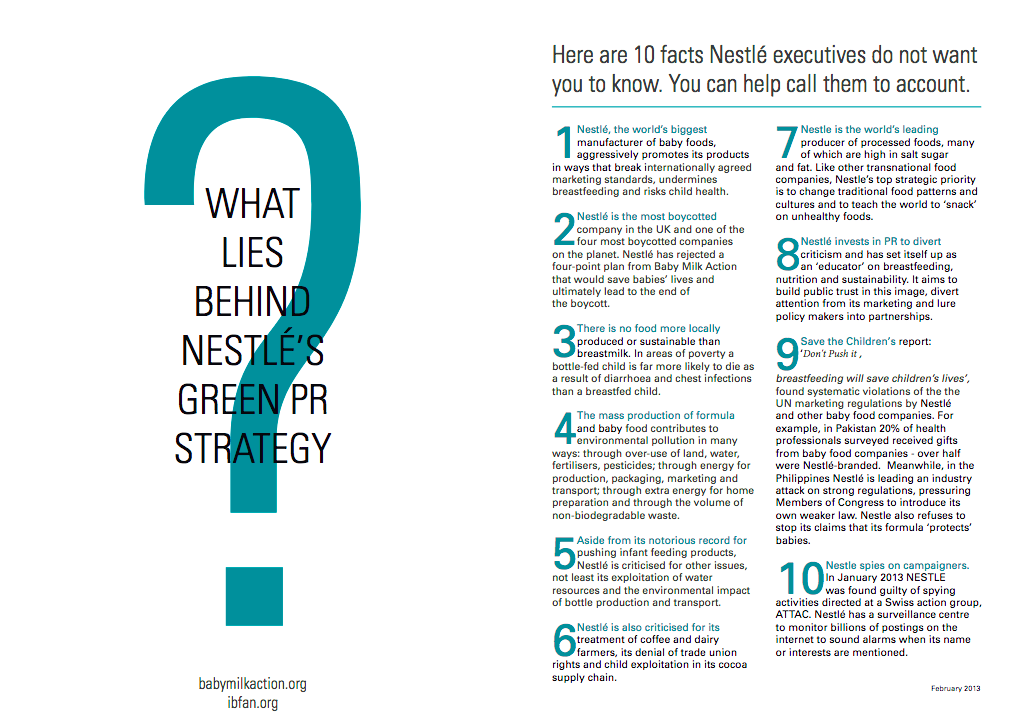 PDF of 10 facts leaflet
[1] https://www.actiononsalt.org.uk/media/action-on-salt/WASSHShareAction-Summary-Report-(1).pdf
https://www.theguardian.com/business/2024/apr/18/nestle-vote-sugar-salt-fats
Nestlé investors urge food giant to lessen dependence on …
“The coalition claimed Nestlé gets 75% of its global sales from products containing high levels of salt, sugar and fat…”. https://www.fooddive.com/news/nestle-investors-lessen-dependence-on-unhealthy-foods/710290/ Food Dive14 Mar 2024
[2] https://www.bbc.co.uk/news/world-us-canada-57522186,
Mars, Nestlé and Hershey to face child slavery lawsuit in US. Guardian Fri 12 Feb 2021https://www.theguardian.com/global-development/2021/feb/12/mars-nestle-and-hershey-to-face-landmark-child-slavery-lawsuit-in-us
Nestlé’s financial troubles:
Nestle CEO shake-up overshadows broader malaise Reuters: John Revill and Oliver Hirt https://www.reuters.com/sustainability/sustainable-finance-reporting/nestle-ceo-shake-up-overshadows-broader-malaise-2025-09-05/
Nestlé and Plastic Pollution. C4 TV documentary: My Family and the Galapagos – 2020 initially sponsored by Nestle – they dropped the sponsorship after I complained. https://www.babymilkaction.org/archives/23937
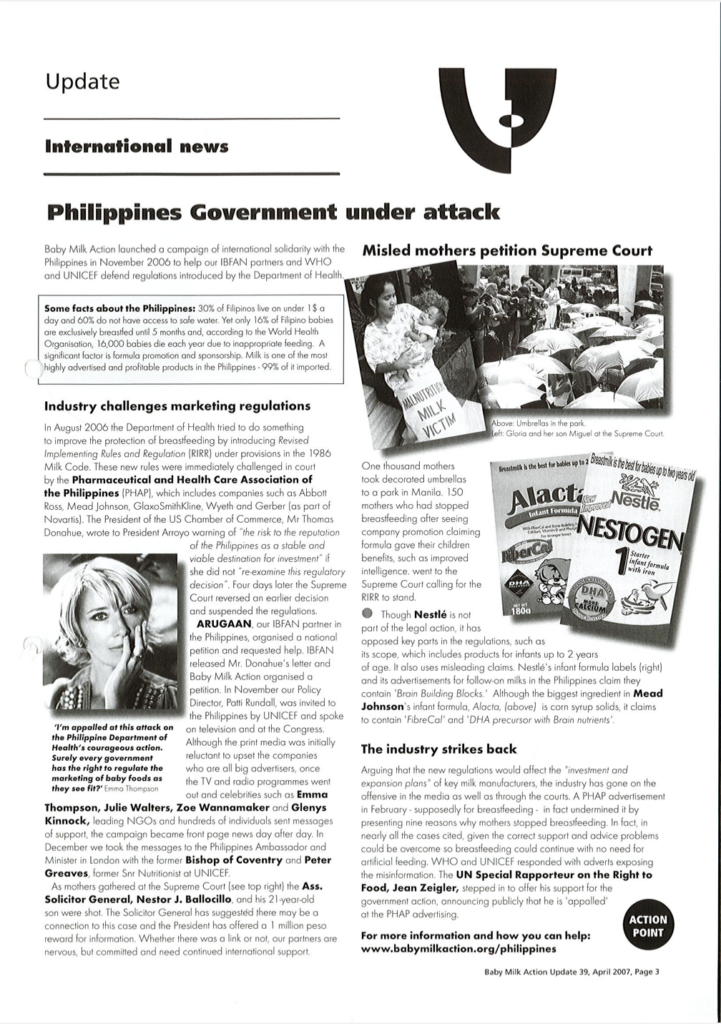
Beware of Nestlé’s deceptive policies
(for more about Ukraine see HERE and HERE and HERE more on emergencies.
(We never include breastmilk substitutes on boycott lists – aware that in some instances they can be the only food available and essential for child survival)
Nestle and Child Slavery. In The Supreme Court of the United States, NESTLÉ U.S.A., INC. , Petitioner, v. JOHN DOE I et al.,
INDIVIDUALLY AND ON BEHALF OF PROPOSED CLASS M EMBERS , Dated: December 12, 2019
Respondents. On Petition for a Writ of Certiorari to the United States Court of Appeals for the Ninth Circuit
Sunday, 8pm 25th April 2021. 20 yrs ago, the Mark Thomas Comedy Product show highlighted Nestle’s harmful baby food marketing on C4. The show looked back at over his exposés of corporate and other wrongdoing. Patti Rundall @pattirundall provided an update on the situation to date.
Campaign materials, Nestlé-Free Zone stickers – click here. Mugs: Give Nescafé the Boot mugs are bac
Boycott overview
Nestlé, the maker of Nescafé, is the target of a boycott because it aggressively markets baby foods around the world in breach of international marketing standards, contributing to the unnecessary death and suffering of infants. Baby Milk Action and its partners in the International Baby Food Action Network (IBFAN) monitor what companies are actually doing on the ground.
Nestlé promotes its baby milk around the world with misleading idealised and unsubstantiated claims such as ‘nutritional foundation for life’ ‘helps develop motor skills’ start’, ‘gentle start’ and ‘protects’ babies. In truth, babies fed on formula are more likely to become sick than breastfed babies and, in conditions of poverty, more likely to die. Nestlé has promised to drop the ‘natural start’ claim by mid-2015 following pressure from the campaign, but not the others.
The World Health Organisation says: “Globally, breastfeeding has the potential to prevent about 800,000 deaths among children under five each year if all children 0–23 months were optimally breastfed.” That is 11.6% of all deaths amongst children under five years old could be prevented by breastfeeding.
Expensive baby foods can also increase family poverty. Poverty is a major cause of malnutrition.
Nestlé targets pregnant women, mothers of babies and young children and health workers to promote its products and boost its sales.
Nestlé also puts babies who need to be fed on formula at risk. It refuses to warn on labels that powdered formula is not sterile and may contain harmful bacteria and does not give correct instructions on how to reduce the risks – unless forced to by law (as in the UK, where it markets the SMA brand).
The boycott holds Nestlé to account and forces it to make changes, while also keeping the issue in the public eye (see Nestlé boycott successes). However, Nestlé continues systematic violations in those countries which have not yet brought in independently monitored and enforced legislation implementing the marketing requirements, which is another part of our strategy for protecting infant health and mothers’ rights.
The boycott will continue until Nestlé accepts and complies with Baby Milk Action’s four-point plan for saving infant lives and ultimately ending the boycott.
Four point plan
1. Nestlé must state in writing that it accepts that the International Code and the subsequent, relevant World Health Assembly Resolutions are minimum requirements for every country.
2. Nestlé must state in writing that it will make the required changes to bring its baby food marketing policy and practice into line with the International Code and Resolutions (i.e. end its strategy of denial and deception)
3. Baby Milk Action will take the statements to the International Nestlé Boycott Committee and suggest that representatives meet with Nestlé to discuss its timetable for making the required changes.
4. If IBFAN monitoring finds no Nestlé violations for 18 months, the boycott will be called off.
As the largest company, Nestlé sets trends others follow. It also takes the lead in undermining regulations implementing the marketing standards. It is now rivalled by Danone, the second biggest company, as a source of violations. Danone is targeted with the DanoNO campaign.
See our briefing on Nestlé for examples of Nestlé marketing practices, with images, links and references.
Register with Baby Milk Action to receive email alerts.
Evidence of Nestlé malpractice
If you doubt that Nestlé is doing anything wrong, see the monitoring evidence in our Campaign for Ethical Marketing section.
 Reports from Save the Children (February 2013) and UNICEF Lao (released April 2013) also highlight violations by companies, with Nestlé being prominently criticised.
We have responded to some of the misinformation given out by Nestlé Public Relations Machine in the report Nestlé’s Creative Storytelling Initiative.
Supporting the boycott
You can register your support for the boycott via our contact page.
You can encourage organisations to endorse the Nestlé boycott. See our sample resolution.
You can find a list of Nestlé’s principal products in the UK by clicking here.
It is important to tell Nestlé you are supporting the boycott – even if only for Nestlé-Free Week.
Materials for promoting the boycott
You can download a Nestlé-Free Zone poster and other posters from our archive site to promote the boycott in your locality.
If you would like to hold a meeting, why not order one of the films in our on-line Virtual Shop?
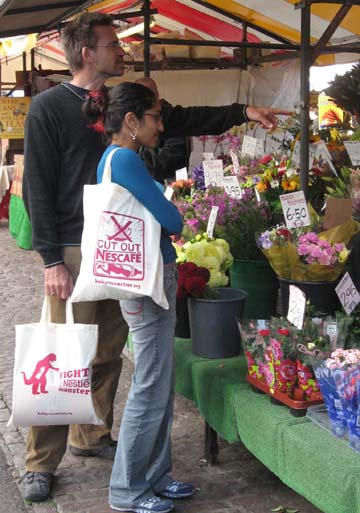 Download our leaflet on why to boycott Fairtrade KitKat.
Very useful items for your campaigning are the product list cards, giving Nestlé’s principal brands.
You could ask people to send letters to Nestlé as part of our Campaign for Ethical Marketing.
If you would like to give a talk yourself you might like to download a powerpoint presentation and a short presentation to adapt for your own use (the text has been checked to be legally accurate – please take care if adding information of your own).
If you like role playing, you could try doing something like the Nestlé challenge stunt Baby Milk Action did at Nestlé (UK) HQ at a past demonstration. Click here for details.
Keep us informed of your activities. It can help to generate international media coverage.

 Nestlé entered the UK market following its takeover of Pfizer Nutrition/Wyeth and the SMA formula brand and ran a series of events targeting health workers to build contact lists and to draw them into defending the company and promoting its interests and products. Nestlé attempts to circumvent the restrictions many health facilities have in place to stop company representatives targeting staff. In these health facilities, companies can only provide information on their products to a designated expert staff member (or a multidisciplinary committee in some regions), who will assess the accuracy and only pass on what is necessary. SMA HA formula has been pushed despite the British Medical Journal retracting the fraudulent research by Prof. Chandra used to build the market http://www.babymilkaction.org/archives/7475
Show your independence from Nestlé using our Nestlé-Free Zone – say NO for formula company sponsorship stickers.
Events break the rules on conflicts of interest
Nestlé claims in the invitations for these events:
‘SMA Study Days are designed to provide educational support to HCPs working in infant and maternity care. They are run in accordance with the aims and principles of the WHO Code for the Marketing of Breast Milk Substitutes and the Baby Friendly Initiative (BFI) standards.’
This is simply not true. See our post Health workers, conflicts of interest and the baby feeding industry for the actual requirements of the International Code and Resolutions and UNICEF Baby Friendly.
The job description for Nestlé’s Clinical Representatives makes it very clear their job is to get health workers to endorse SMA products: http://www.babymilkaction.org/archives/3653
Working with the NHS at a territory level, you’ll be developing long-term, mutually beneficial relationships with key stakeholders and opinion leaders to support brand endorsement and strategically aligned education for Healthcare Professionals.
Protests to raise concerns about conflicts of interest
In the past Baby Milk Action organised many protests to encourage anyone turning up to consider the conflicts of interest in attending a company event. These events raised awareness of wider concerns about Nestlé practices. Baby Milk Action produced a kit of materials for anyone interested in demonstrating or alerting management to remind staff of their policies on meeting with company reps. The UNICEF Baby Friendly guidelines are useful on this point – click here.
Nestlé’s SMA-branded website)
We are looking to to hand leaflets to anyone arriving at the start of the events (leaflets, placards and guidelines will be provided). During the registration period, Nestlé generally provides a buffet and promotes SMA products on a stand, as well as during the event.
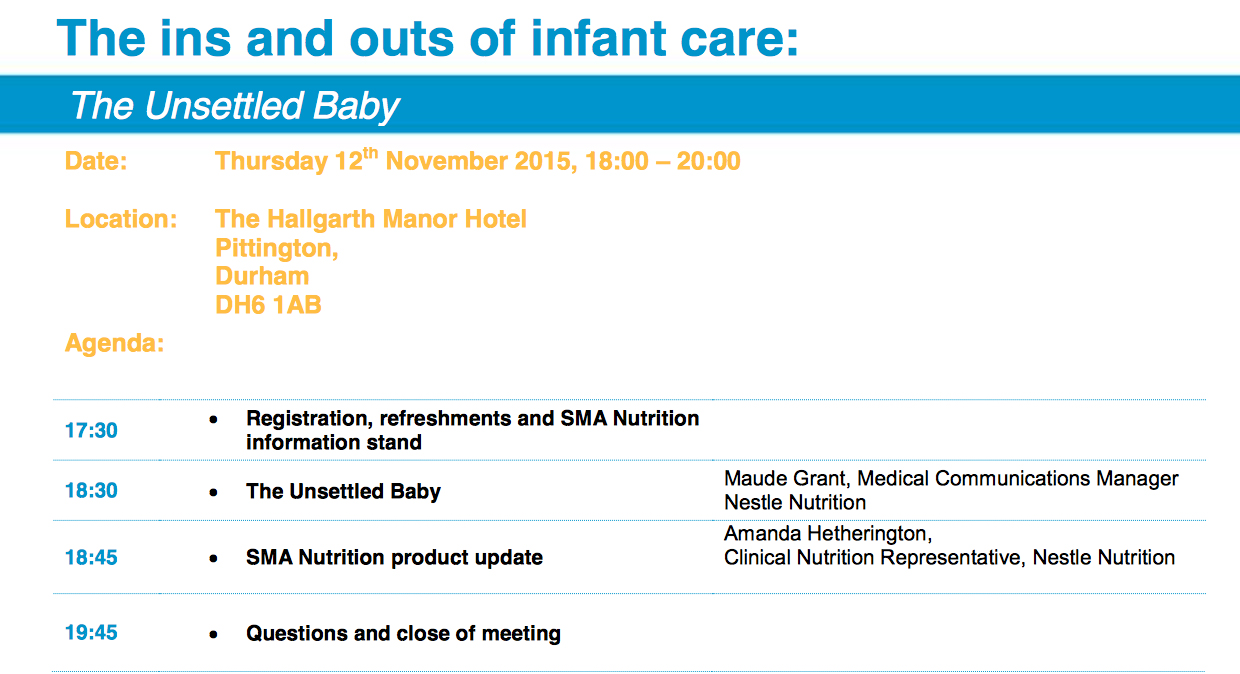
Date: 12/11/2015
Location: Durham, Hallgarth Manor Hotel, DH6 1AB.
Time: Leafleting from 17:45 for 18:00 event start.
This event is ostensibly about the “Unsettled Baby”, but the programme shows there is an hour of product promotion at the start and at the end. The session on the headline subject is just 15 minutes long – and the speaker is from Nestlé in any case!
Join our email alert list to receive updates on events.
You can also join the Baby Milk Action Facebook group. Click here.
Nestlé-free zone banners and logos
If you have a website, why not place this banner advertisement there?

For the image to automatically update on your site, don’t copy it, but link to it using :
http://www.babymilkaction.org/flash/nestlefreebanner.gif
For simplicity, you can copy the code below into the html source code of your web page or add it to your blog when in ‘edit html’ mode. With a myspace blog, you can add the code directly. With some blogs, you will have to add the link as a separate line. Simply add the URL:
|
<a href=”http://www.babymilkaction.org/nestlefree” target=”_blank”> |
Alternatively use the following image to link to this page.The image address is:
http://www.babymilkaction.org/flash/nestlefreezone.gif

If you use a service such as blogger, you can go to the ‘settings’ control panel and add an html page element. Cut and paste the text below into the field for the html and the image will appear with a link to this page! Click here for an example.
|
<p align=”center”> |
Alternatively use the following image to link to this page. The image address is:
http://www.babymilkaction.org/flash/nestflown.gif
Email Nestlé and your friends
If you are supporting the boycott, please send an email to Nestlé.
To tell people about the boycott by email, you could cut and paste the following text and adapt it to send to your friends, family and colleagues.
|
As you probably know, I support the boycott of Nestlé products. According the the World Health Organisation (WHO) improving breastfeeding practices could prevent 800,000 child deaths every year. Despite this Nestlé continues to push its baby milks in breach of international standards. Nestlé is the largest of the baby milk companies. Monitoring by groups on the ground around the world shows Nestlé systematically violates the marketing requirements and drives down standards for the industry as a whole. That’s why it is singled out for boycott action. If you don’t boycott Nestlé already, I ask that you consider looking at the evidence and giving up Nestlé products, or at least its principal brand, Nescafé coffee. The boycott has forced some changes from the company, but it is still a long way from complying. Campaigners are also working for laws. Nestlé can comply when it is given no choice. It is not being asked to do something that is impossible, but without pressure it continues to put its own profits before infant health and mothers’ rights. You can find out more information and look at the evidence yourself on the Baby Milk Action website at: http://www.babymilkaction.org/nestle-boycott You can sign up there to support the boycott. It is important to tell Nestlé you will be boycotting it until it accepts and acts on the plan put to it by boycott groups for saving infant lives. You can telephone Nestlé on the (UK) freephone number 0800 00 00 30 or send a message via its website http://www.nestle.com/ |